Until I moved to San Diego, I thought a palm tree was, well, a palm tree. But the longer I lived here, I began to notice differences. When I made a switch from riding my bike everywhere to walking more, I found myself recognizing the different shapes, different trunks and even different fruits of local palms.
With the help of the Google Lens app, it turns out that identifying palm trees is surprisingly easy, and it’s added a new layer of interest to my everyday walks around downtown. (FYI: Botanically, palms are more closely related to grasses than trees).
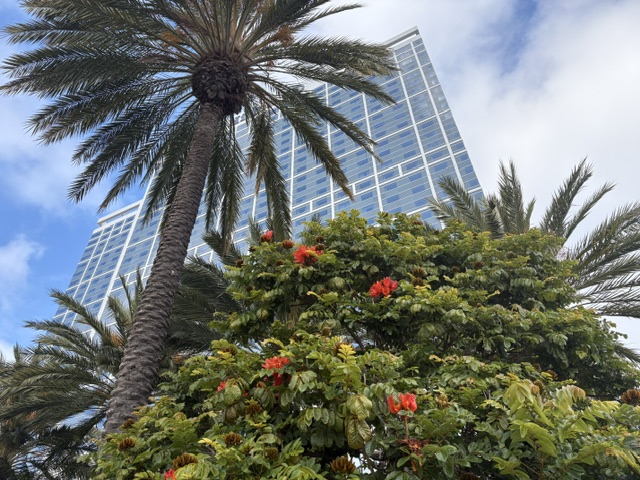
The grand palms along the waterfront. Some of the most impressive palms downtown are those towering outside waterfront hotels and along the walkway in front of the San Diego Convention Center. According to Google Lens, these are Canary Island date palms, recognizable by their thick, textured trunks and massive crowns of arching fronds.
Other palms I spied near the convention center were Mexican fan palms (a nice, drought-resistant option that can reach up to 100 feet tall) and king palms (which have more of a lush, tropical feel).
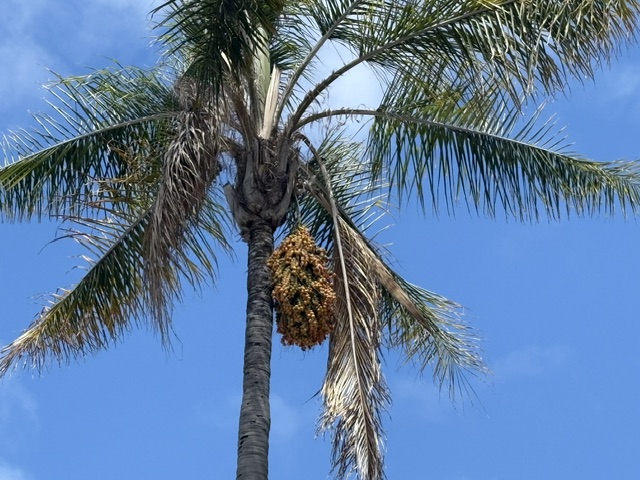
The palms dropping orange berries. A very different palm caught my attention near the downtown Post Office on E Street.
If you’ve approached the post office lately from Ninth Avenue & F Streeet, you can’t miss the hundreds of small orange fruits scattering the sidewalk. Looking up–and again with the help of my digital companion–I realized these were queen palms, another common species planted throughout San Diego.
Compared with the sturdy Canary Island date palm, queen palms have smooth, gray trunks and more graceful, feathery fronds. Their bright orange fruits appear in huge hanging clusters. While these fruits may be a critical food source for the birds, they create messy sidewalks.
Other apps to help you identify plants. In addition to Google Lens (which often comes loaded on smartphones), the most popular identification app is iNaturalist, and it’s completely free. iNaturalist not only helps you identify the plants and animals around you, but it also generates data for science and conservation.
If you have a child in your family under 13 years of age, iNaturalist has a companion app called “Seek” that gamifies plant and animal identification. Kids, and the young at heart, can earn badges and take part in challenges to observe species. Also free.
The next time you’re exploring downtown, challenge yourself to identify a palm. SDSun
Award-winning columnist Deanna Ratnikova is the creator of The GO Deck – grab a deck today and be inspired to Get Outdoors and GO on new adventures.