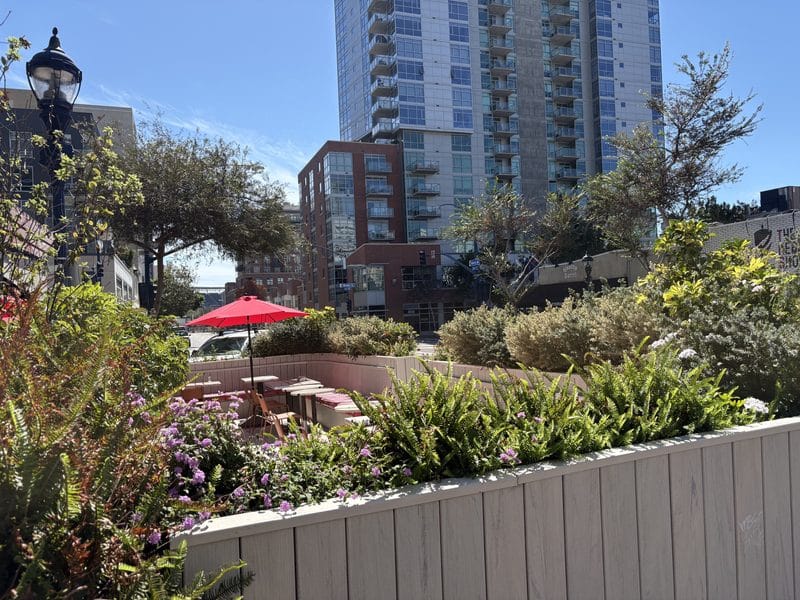

The San Diego-Tijuana region has begun its year-long reign as World Design Capital.
Every two years, the World Design Organization recognizes a city for “effective use of design to drive economic, social and environmental development.” This is the first time the WDO has picked a city in the United States.
2024 is also the first year binational cities were co-selected to share the designation. San Diego-Tijuana edged out Moscow in a 2021 vote.
Since it began in 2008, previous sites have included Torino (Italy), Seoul (South Korea), Helsinki (Finland), Cape Town (South Africa), Taipei (Taiwan), Mexico City and Lille Metropole (France).
What does the distinction entail?
Throughout 2024, the WDO will endorse a series of events and projects in the region, including conferences, festivals and design installations focusing on arts, culture and spaces.
The Montreal (Canada)-based WDO advocates for “Design for a Better World.”
Organizers are working to publicize the effort, which hasn’t picked up a great deal of steam, yet. In January, the local organization’s CEO, Carlos de la Mora, was fired, according to reports.
A World Design Capital calendar of events for San Diego and Tijuana exists and is expanding.

One downtown San Diego initiative that’s out of the starting blocks is the Bay-to-Park Paseo. The project aims to connect the San Diego Bay to Balboa Park using the 1.7 mile stretch of Park Boulevard as a walkable path.
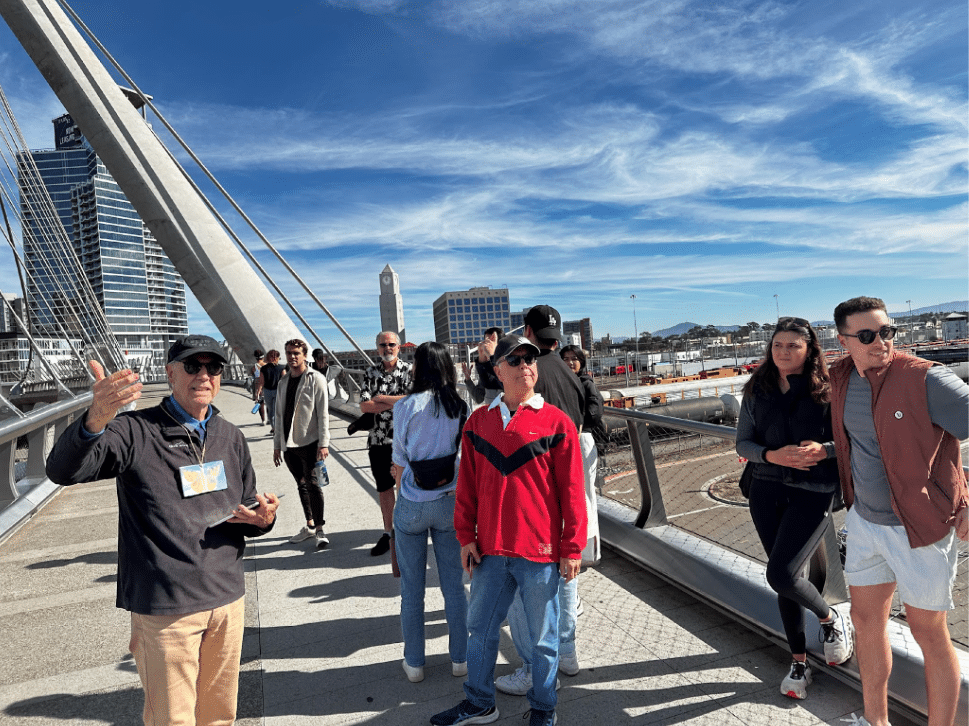
Along the route there are big landmarks – the Harbor Drive Pedestrian Bridge, Petco Park and the Central Library – along with installations created by local designers and artists.
“It’s really about connecting the two crown jewels of San Diego, which are the bay and Balboa Park,” Bay-to-Park Paseo co-creator Pete Garcia says. “And the way to do that is to convert Park Boulevard by making it clean, safe, interesting, memorable and by having a big payoff when you get to the park.”
By promoting new installations, Garcia hopes to illuminate San Diego as a more walkable community.
“We [San Diegans] sort of squandered our city’s natural beauty and climate because we don’t want to walk,” Garcia said. “We’re trying to establish the ethos of a walkable, leave-the-car-behind community and eventually create a tapestry of ‘Paseos.’”
The Bay-to-Park Paseo is described as an “impermanent pedestrian experience.” Installations aren’t meant to stay up beyond a year or so. However, Garcia and co-creators Chloé Lauer and Beth Callender hope the Paseo will become a part of San Diego’s cultural fabric.
“Our hope is that people come to know the Paseo as one of the things to do as a visitor to San Diego,” Lauer says. “We want there to be a natural buzz, for it to become part of the conversation around being in and enjoying San Diego.”
One installation along the Paseo is a project near the entrance of the Central Library called “Before There Were Borders.” This project aims to highlight regional history through the eyes of indigenous peoples, such as the Kumeyaay/Kumiai, Payòmkawichum, Kuupangaxwichem and Cahuilla.
Co-founder of Our Worlds and installation contributor Catherine Eng has been working with the Central Library to develop an experience that intertwines the library’s archives with indigenous knowledge and tradition.
“There are the archives in the library, and then there’s indigenous wisdom,” Eng says. “So how can those knowledge systems intersect better? You can read or talk about one or the other, but they don’t really exist in any sort of space or narrative together. This piece combines art with architecture and the voices of the community.”
Eng says it’s important to recognize how indigenous cultures from Mexico and the United States overlap.
“It has been most rewarding to see the diversity of installations and exhibits that are planned,” Callender says. “They’re all very unique, and all highlight top-of-mind themes in our region, like the border, climate and sustainability. The art installations are both wonderful to look at and they’re telling a story.”
More than a hundred years ago, the idea for a “Paseo” from the San Diego Bay to Balboa Park was favored by town planner and landscape architect John Nolen. Since then, the idea has been popular with San Diego urban designers, but never pursued.
“For many years, people talked about it, and everybody thought it was a great idea,” Garcia says. “But it’s a very ambitious project. It’s daunting. We finally decided to just do it.”
Installations along the Paseo are still being set up. There are guided tours along the route led by Garcia every Saturday at 10:30 a.m. starting at Bayfront Park. The grand opening parade for the Bay-to-Park Paseo is scheduled for 1 p.m. on Saturday, April 13, weather permitting. SDSun