
Josh George has never let limitations get in the way of his dreams.
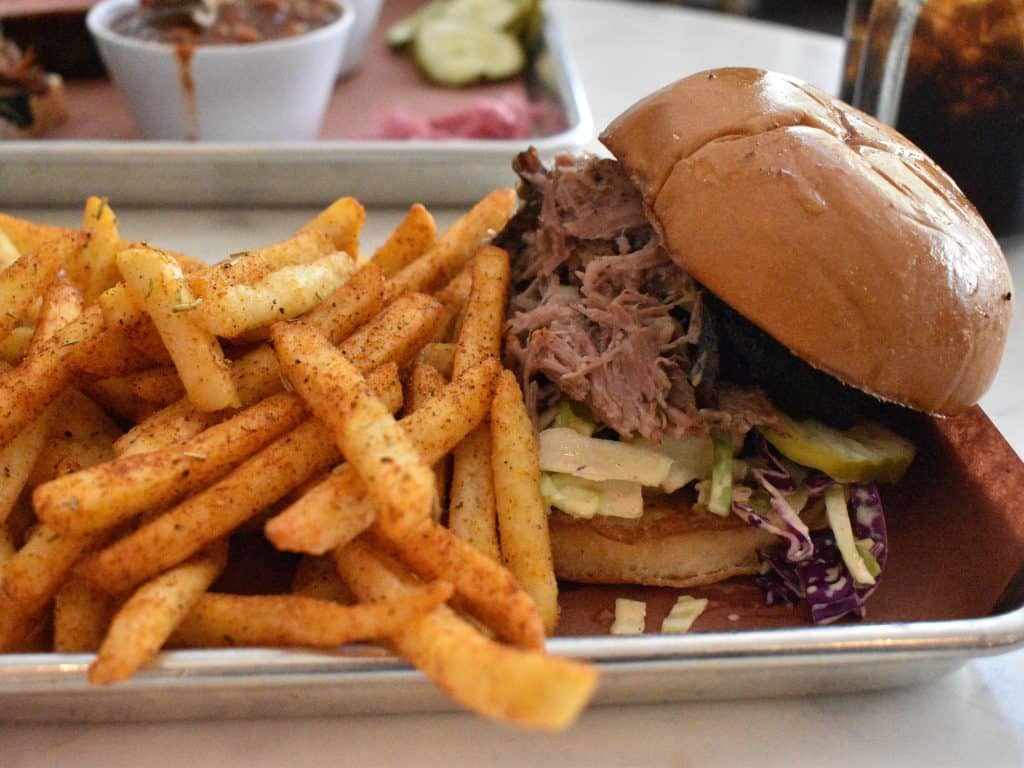
The East Village resident competed for the United States in five Paralympics competitions (from 2004 to 2021) and currently co-owns Smokin’ J’s BBQ on Fourth Avenue in the Gaslamp Quarter.
George, 39, moved to San Diego in 2018 to help his brother, Jeremy, get the barbecue business off the ground.
“My brother started the business by borrowing money from me to buy his first smoker,” George says. “The first gig he tried was on Super Bowl weekend in 2017. He was in North Park all day trying to sell ribs.”
He sold exactly two stacks of ribs that day.
Now, the enterprise has three brick-and-mortar locations, including sites in Poway and Miramar. George runs front-of-house operations and his brother directs culinary and back-of-house operations.
“We’ve been fortunate enough to establish ourselves as a part of the community in Poway,” George says. “And the Poway restaurant is doing really well, which has allowed us to expand and open our Miramar and Gaslamp locations. We’re hoping we can become a part of these communities, too.”
Smokin’s J’s has faced challenges along the way: Skeptics. Grease fires. A water crisis in Poway. The pandemic.
George’s positive attitude and grit are traits he acquired long before getting into the restaurant business.
“I had an accident when I was 4 years old,” says George, who grew up near Washington, D. C. “I fell out of a window and damaged my spinal cord, amongst other things.”
Before that, he’d been an active kid. After the accident, he says his parents wanted to find new ways for him to stay active. They scoured the area looking for programs that provided athletics for kids in wheelchairs.
They found a Baltimore program that was a good fit. George was enthusiastically involved in everything from track and field to swimming, tennis and basketball.
“In the schools I went to, I was the only kid in a wheelchair,” George says. “That was the case in elementary school, middle school and high school. The sports world was where I got to connect with other kids with disabilities, and form a group of friends that were dealing with the same stuff I was.”
He had able-bodied friends, too, “but they didn’t have to navigate the world the way I did,” he says.

At the University of Illinois, George studied journalism and continued his athletic pursuits.
He made his first Paralympic team in wheelchair racing and competed for the United States in 2004 at the Athens games. He won a pair of bronze medals. It fueled his competitive spirit and spurred him to become a professional wheelchair racer.
Among his successes: George won a gold medal in the 100-meters and a silver medal in the 800-meters at the Beijing Summer Paralympics in 2008, and bronze in the 800-meters in the London Paralympics in 2012. He’s also a six-time world champion wheelchair racer.
During the London Paralympics, George got to fulfill a journalism goal and wrote an insightful blog that ran in The New York Times.
Traveling the world for his athletic career, George supplemented his income by working as a motivational speaker at sales events, company meetings and for community groups and schools.
“My message was always about focusing on your abilities and approaching your limitations with creativity,” George says. “I’ve always found that limitations lead to the most creative ideas.”
It’s an addictive thing to see that path, he says.
“The harder I train, the better I race, the better I play in the game,” George says. “It taught me how to work hard, how to train my body, and then see it pay off.”
Smokin’ J’s opened up a new chapter for George as he retired from his Paralympic career.
“I was thinking that there’s a bit more to life than just being an athlete and training and racing all the time,” George says.
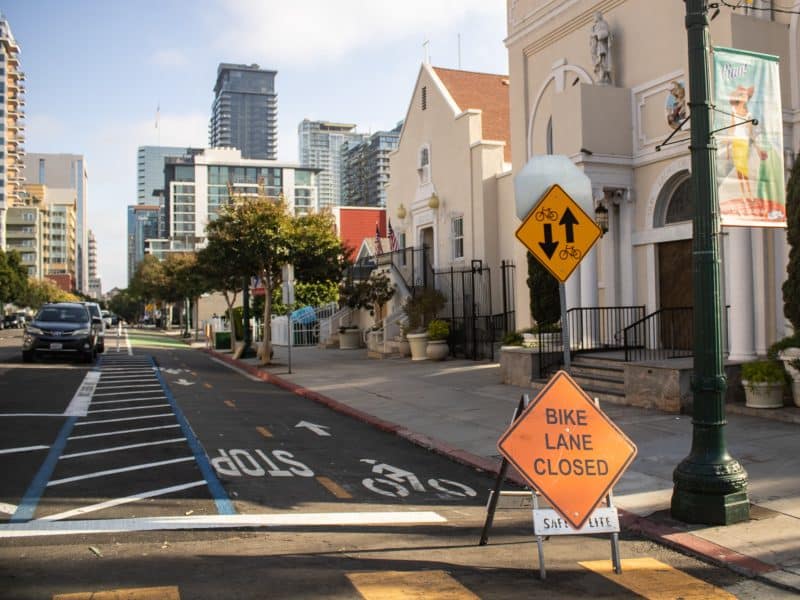
Since moving downtown to San Diego’s East Village, George has faced other challenges. He identifies two primary obstacles: Accessible housing and navigation issues.
“By ‘accessible housing’ I don’t just mean that we need housing where there aren’t only steps up to the front door, or once you get into the dwelling there’s at least one bathroom that’s big enough for a wheelchair,” George says.
He’s talking about costs.
“We already live in the most expensive city in the United States – a big part of that is how expensive housing is,” he says. “As someone who uses a wheelchair, that gets even trickier and more expensive because a lot of affordable housing options are inaccessible.”
He says he’s fortunate to be a business owner of a company that’s doing well.
“I can afford a place to live,” George says. “But that puts me in the tiny minority of people with disabilities who are able to do that independently.”
Then there’s the issue of navigating downtown.
“Structurally, San Diego is as accessible as any other city in the country, but that’s thanks to the ADA,” George says. “But it’s no secret that we have a massive homeless population, and there are issues that come with that.”
He points to a recent period of time where downtown was hard to navigate in a wheelchair because homeless tent encampments would take up the entire sidewalk on some blocks.
“An able-bodied person would be able to briefly step into the road, walk around the tent, and then step back onto the sidewalk,” he says. “For me, I would have to avoid the block.”
Although accessibility issues make navigation a bit more difficult, George is able to get to most places easily without using public transportation or a car.
He’s a big-picture optimist.
On the whole, he believes everybody should maintain a positive life outlook when assessing their limitations.
“How you approach those limitations can put a ceiling on whatever you define as success,” he says. “Or, it can open up the world to you in ways that you didn’t think were possible.” SDSun