Borders are an implicit concept in American life. In many indigenous languages, however, there is no word for “borders.”
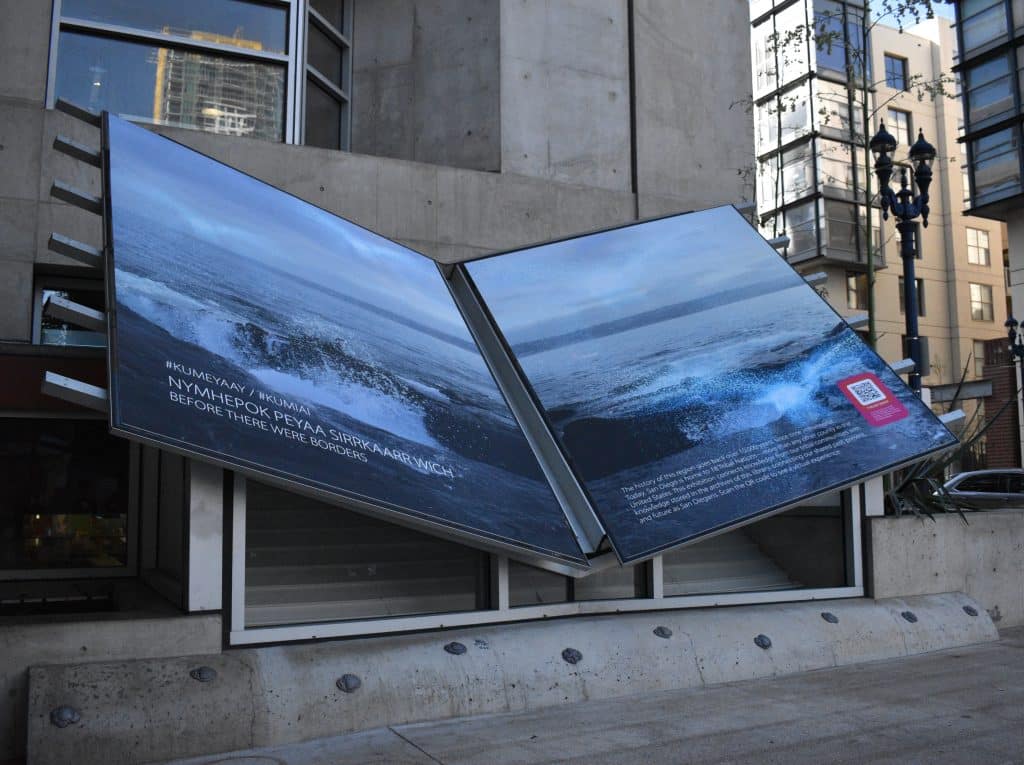
This duality is at the heart of “Before There Were Borders,” an installation currently located outside the Downtown Central Library in San Diego’s East Village. A dedication and blessing was held earlier this month.
The installation was produced by Our Worlds and local Native American tribes. Just in time for Native American Heritage Day (November 29), the display puts indigenous culture in the digital space.
“When we asked everyone to help us translate the title in their language, in no case did they have a word for borders,” Our Worlds Co-founder Catherine Eng says. “That’s the thing I want people to know. I think it’s the beginning of altering the way that we can look at the lands around us.”
The installation is designed to look like two large, open books. Four window panels show sprawling murals of locations that represent historic tribal sites. Each mural has a QR code that can dynamically immerse viewers into that history.
“Our Worlds represent a new way of working with the community,” Eng says. “It can’t just be that we worked with one or two people. It has to be collaborative… It is really important to get the community to have buy-in.”
Eng designed the installation with a focus on the voices of tribal community members.
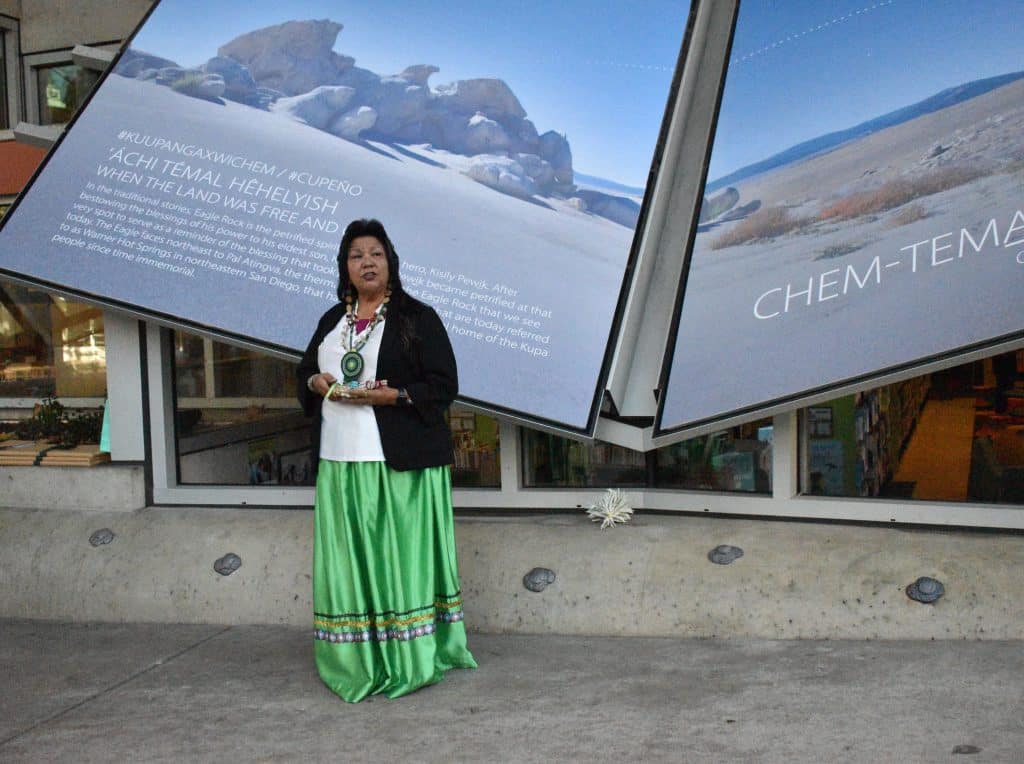
In many indigenous cultures, traditions as precious as language are at risk of being lost. Adapting to digital record-keeping has become a priority for many tribes, says Pala tribal elder Diana Duro.
“Today, I thank my cousin because he said these very important words: We must adapt,” Duro says. “We live in a digital world, and us older people must adapt to the younger generations, especially for keeping our language.”
Duro says the installation celebrates the “Kupa people,” referring to the ancestral name of the Pala Band of Mission Indians.
“This is the first time for us to have anything like this up in the air in the city for Kupa people,” Duro says. “My heart is happy. If my grandmother was here, she would be so proud. It’s something that she would never want us to forget.”
Duro’s son, Elijah, also believes the public display is a step in the right direction.
“Among future generations I think it’s a good idea to bring different tribes together,” Elijah Duro says. “It can plant the seed in many young ones, inspiring them to do bigger things.”
Elijah says social injustice still exists in 2024.
“We’re still fighting for our property,” he says. “We can’t even go back to our property now; it’s all privately owned. One of my missions is to always fight for our recognition and the rights that we have as indigenous people.”
Initially, “Before There Were Borders” was one part of the Bay-to-Park Paseo initiative, a project brought to life during San Diego’s reign as 2024 World Design Capital. Proponents think these efforts can have ongoing impact.
“Having a space for people from our region who don’t necessarily [get to] to express their culture, their language, their pride…it was super meaningful,” Bay-to-Park Paseo co-creator Beth Callendar says. “I’m surprised we don’t have more spaces like that.”
In the coming months, the plan is for two more murals to be added to the current window panels on library display. SDSun