Lucky Duck Foundation CEO Drew Moser is tirelessly carrying on a tradition of goading politicians into action on homelessness. That mission was eloquently spearheaded years ago by influential foundation member and late San Diego Padres owner Peter Seidler.
“Politics is a waiting game…and there’s too much lip service,” Seidler told The San Diego Sun back in 2021.
“We push the politicians,” Seidler added. “But we try to build the best possible relationship and work with politicians and make them look good for advocating things that work…Every few years we get a new set of politicians. Most of them care. But most of them know nothing about homelessness.”
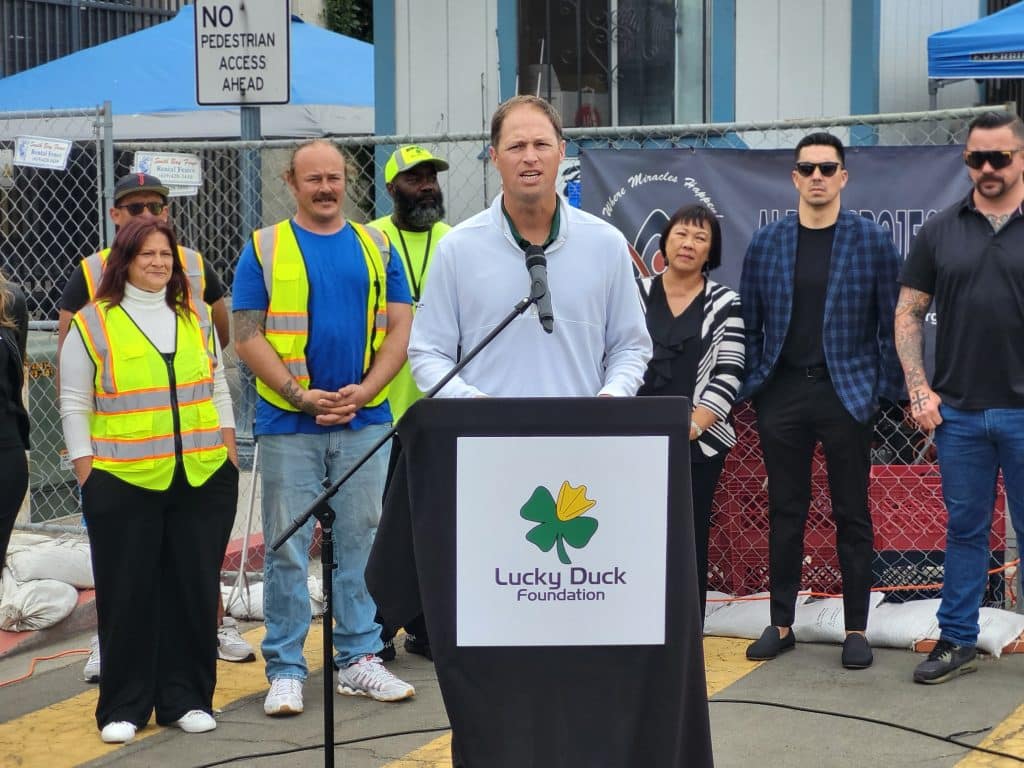
Earlier this month, Moser and other prominent advocates for the unhoused gathered outside a 326-bed shelter in Barrio Logan run by Alpha Project. The press conference occurred before San Diego Mayor Todd Gloria’s city budget was finalized. At the time, it called for reducing the number of beds in this always-packed shelter at 16th Street and Newton Avenue.
Moser noted that availability in the region’s current shelter capacity is so low that on any given day nine out of 10 unhoused individuals who request shelter are denied.
“Reducing shelter capacity at any level is deeply concerning,” Moser said. “Whether it’s 50 beds or 250 beds, any idea of reducing immediately available shelter beds should absolutely not happen.”
After the city’s 2027 fiscal budget was finalized on June 9, the city council voted to reduce capacity at 16th and Newton by 50 beds.
City of San Diego Media Services Coordinator Matt Hoffman said via email “reducing homelessness remains a top priority.” He said the city’s FY ‘27 budget calls for adding 200 total shelter beds.

Moser said later that he’s heard the claim of a net gain of 200 beds but has not seen any specifics. He’s waiting for the city to “get back to us with a meeting time to discuss next steps.”
Moser has repeatedly said Lucky Duck is ready to step up and help by using its own funds for shelter beds. At 16th and Newton, the shelter is a giant sprung tent that’s owned by Lucky Duck. Moser said the foundation would cover costs in full there, including a flood prevention plan.
One concern Moser has for the homeless population is the rising average age of shelter residents. In 2026, he said 34% of residents were over the age of 55. That number is up from 26% a year ago.
Lucky Duck has also funded an online reminder for anyone who wants to check on the progress of the city’s shelter capacity. The “San Diego County Homeless Emergency Bed Dashboard” was created by Homelessness Hub at UC San Diego.
It exhibits current total facility-based shelter beds for 12 local jurisdictions, dating back to 2014. These numbers are provided by the annual Point In Time Count.
The dashboard shows that in 2020 (just after Covid) the total number of emergency beds shot up countywide from 2,400 to 4,500 (those numbers include hotel/motel vouchers and inclement weather beds). When Covid broke out, more than a thousand shelter beds were added inside the downtown San Diego Convention Center.
From 2021 to ‘23, the number of countywide beds remained roughly the same, but collectively dropped by 1,000 beds to 3,500 over the past three years, according to the dashboard.
“The Lucky Duck Foundation will publicly track shelter inventory in every city moving forward,” Moser said. “To ensure transparency, accountability and a continued focus on adding, not reducing, immediate pathways off the streets.”
Moser added, in the Lucky Duck tradition espoused by Seidler and others, “We’re not here to criticize anyone. Rather, we’re here to help, and to elevate the facts of the current state of homelessness in San Diego County.” SDSun