Merchants in the Gaslamp Quarter have been frustrated for years by illegal sidewalk food vendors. Beyond the matter of legal operation, people are concerned some vendors are health and safety risks to customers and are dumping grease in city gutters, which lead into the ocean untreated.
“It’s a bad look,” Gaslamp Quarter Association Executive Director Michael Trimble said.
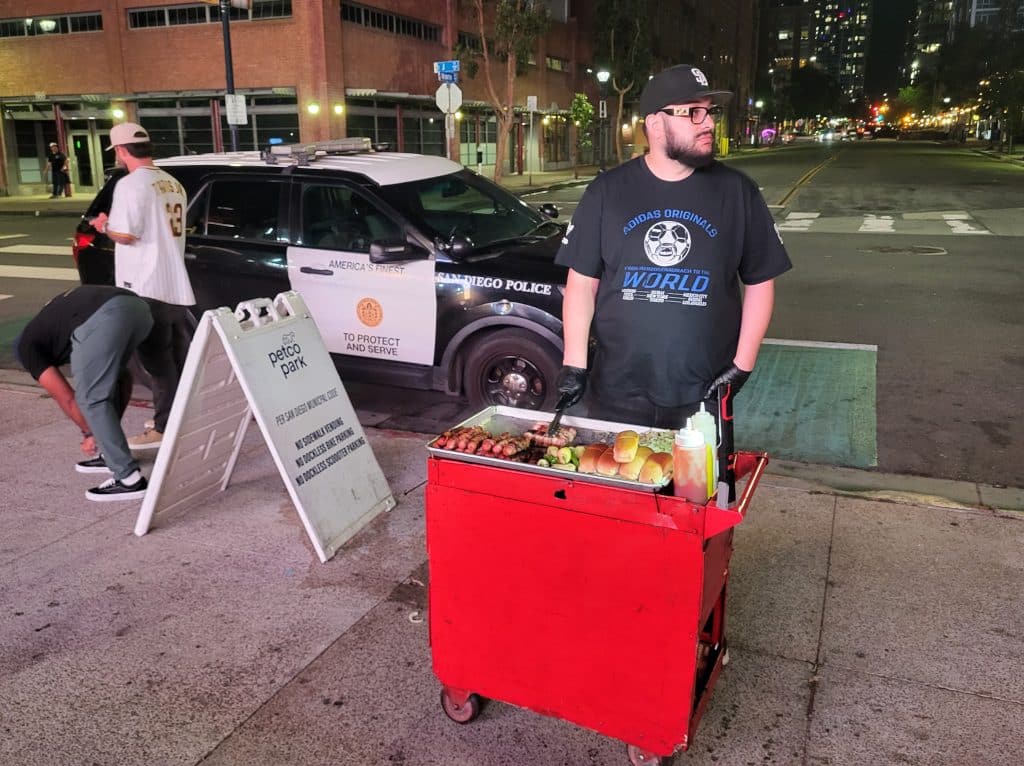
At the center of the controversy are vendors who sell hot dogs from red carts in the city.
Ruth-Ann Thorn, owner of Native Star boutique and Exclusive Collections Gallery in the Gaslamp Quarter, purchased property in 2024. She said illegal vending is a hit to brick-and-mortar businesses and believes the vending issue is simple: It’s illegal and should be enforced as such.
“It’s so much of a slap in the face to merchants that have done things the legal way, the right way,” she said.
Thorn warns without enforcement, business vacancies will continue to rise and impact the city’s tax revenue.
“If you come into San Diego and there’s no more nice galleries, no more restaurants, no more anything, it’s just vacant,” she said. “Nobody’s going to be booking to come here for holiday or conventions or anything else.”
Vending enforcement stretches across city and county departments. They’re responsible for playing a role in ensuring vendors operate according to vending, health and safety, and environmental regulations. San Diego city and county representatives said they can only provide limited enforcement of vending in downtown San Diego due to legal concerns, resource limitations and vendors lacking identification.
The GQA is pushing back.
At the nonprofit merchant association’s board meeting last week, Trimble outlined three strategies to call enforcement to action: revising the state’s vending law, gathering video evidence of health and stormwater code violations and securing federal funding for enforcement.
“Just making noise sometimes doesn’t work as much, so now we’ve got to be creative and try to solve this problem because it’s not going to go away by itself,” Trimble told The San Diego Sun.

Revising state law
The city and county say current California law allows for administrative enforcement not criminal enforcement. They can issue fines and educate vendors on proper permitting and requirements.
Public officials are concerned about discrepancies between the city’s vendor ordinance and state law. Separate lawsuits by a long-time legally permitted street vendor, and a group of Gaslamp Quarter business owners, are also part of the reason law enforcement has backed off on enforcement.
According to the GQA’s March board minutes, San Diego Police Department Captain William Brown said a department order restricted direct enforcement of vending violations. Police can only take action when there is a separate violation or offense. He noted the need to protect officers from unclear enforcement directives and the city from liabilities.
An SDPD communications official said officers have “fewer enforcement options available to them.”
“Recent court rulings involving the city’s street vending ordinance have limited what police officers can do to enforce street vending laws,” SDPD’s Ashley Nicholes said. “For example, officers currently cannot impound vending equipment, and enforcement in the Ballpark District is restricted.”
Trimble recognizes the city’s limitations and is looking to change the state’s vending law as a potential solution.
He proposed an amendment to Senate Bill 946, the state law that decriminalized street vending in 2018. The amendment would make certain vending violations a misdemeanor offense punishable by a fine of up to $1,000 or six months in county jail. It would also give enforcement agencies authority to temporarily detain vendors to determine whether they have identification, possess valid vending authorization and permits, and are in compliance with the no-vending-zone restrictions.
Trimble’s amendment concept specifies temporary detentions should not be used for immigration or citizenship status inquiries.
An amendment would require a state legislator to agree to author it before it could move through the legislative process.
FROM THE DOCUMENTERS: This story was written by Brisa Karow, a San Diego Documenter. The Documenters program trains and pays community members to document what happens at public meetings. It’s run by inewsource, a nonpartisan nonprofit newsroom dedicated to investigative and accountability journalism. Read more about the program here. BECOME A DOCUMENTER
Enforcing code violations
Beyond legal matters of sidewalk vending, people are concerned vendors are causing health and safety risks and polluting local waterways.
On an average weekend, Trimble said the Gaslamp Quarter can easily have at least 50 vendors, especially on Fifth Avenue and near Petco Park. Some of the most common vendor violations the GQA board sees are improper food handling and refrigeration, unsafe propane use and open flames, and dumping grease into the street or storm drains.
“People come out and they cook on open flat pans with open propane, and then when they’re done cooking the hotdogs, they just dump [grease] in the street,” Trimble said.
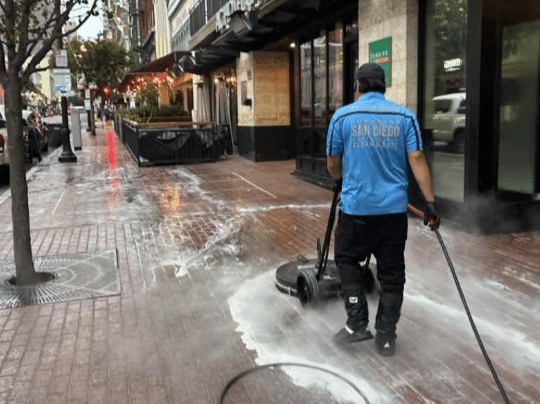
Downtown San Diego Partnership VP of Government Affairs Justine Murray said her organization’s Clean & Safe division is spending more time and resources cleaning grease off streets and sidewalks in the Gaslamp, especially near the ballpark.
“In many cases, our teams clean the same location only to return the next week to address new grease spills,” Murray said. “While our Clean & Safe teams respond quickly and effectively, the recurring nature of grease spills requires additional maintenance, specialized cleaning, and repeated power washing to keep sidewalks safe and sanitary.”
Property owners are funding these cleanup efforts, she said.
When grease is dumped into or enters storm drains, it also becomes an issue under the city’s Stormwater Department.
City of San Diego Public Information Officer Ramon Galindo said the Stormwater Department “takes all reports of potential illicit discharges seriously,” though they can only “take enforcement action if the responsible party can be identified through evidence or direct observation.”
Galindo encouraged people to document and report illegal dumping through the city’s Get It Done app.
Health and safety code enforcement is similar.
County spokesperson Donna Durckel said she believes current state law only allows law enforcement and code enforcement to issue fines “after they have observed the same vendor numerous times.”
Durckel said when there are “egregious” violations or complaints in an area, the county conducts sweeps with law enforcement and code compliance teams. These operations “have historically been conducted later in the evenings,” she said.
The last downtown sweep was near Harbor Drive in May 2025.
To gather evidence of code violations, the GQA is planning to hire a video crew to document vendor activities, mostly after 5 p.m. and until vendors wrap up at night. Trimble said a request for proposal for a video crew will go out in the coming weeks and the board will vote to include it in the budget at their August meeting.
Funding vending enforcement
Trimble noted a major discrepancy in enforcement comes from differing working hours between vendors and enforcement officers. Vendors are most active late at night and on weekends. The city and county don’t always have an overtime budget for enforcement operations.
SDPD’s Nicholes said contributing factors to the police department’s limited enforcement include “ongoing staffing shortages, limited overtime resources, and the need to prioritize emergency calls and violent crime.”
Stormwater code compliance officers conduct inspections during regular 9-5 business hours, Monday through Friday.
Durckel said Department of Environmental Health and Quality staff respond to “as many unpermitted food cart vendor complaints as [they] can with limited resources,” and are also responsible for regulating more than 15,000 retail food businesses and 1,250 permitted mobile food trucks and carts throughout the county.
Trimble wants the city to apply for grant opportunities to fund enforcement. One set of federal funds he has identified is the Department of Justice Model Cities Initiative, which will award up to $300 million each to two to four midsize cities. However, it requires the awarded cities to work with federal immigration officers.
Trimble said he thinks it may be a longshot to get San Diego on board with the immigration-related requirement. SDSun
Brisa Karow is an independent journalist living in San Diego. She is part of inewsource’s San Diego Documenters program and regularly reports on local government throughout the county.
[Editor’s note] On July 6, this story was edited to reflect that not all vendors are to blame for the complaints made in the Gaslamp Quarter.