For years, the city of San Diego has made futile stabs at curtailing the activities of illegal downtown sidewalk food vendors. After unsuccessful attempts at legislation and uneven enforcement efforts, a group of Gaslamp Quarter business owners filed a $12-million lawsuit against the city for ineffectively enforcing an existing ordinance.
One problem is that the city’s vendor ordinance may not align with a state law that protects sidewalk vendors.
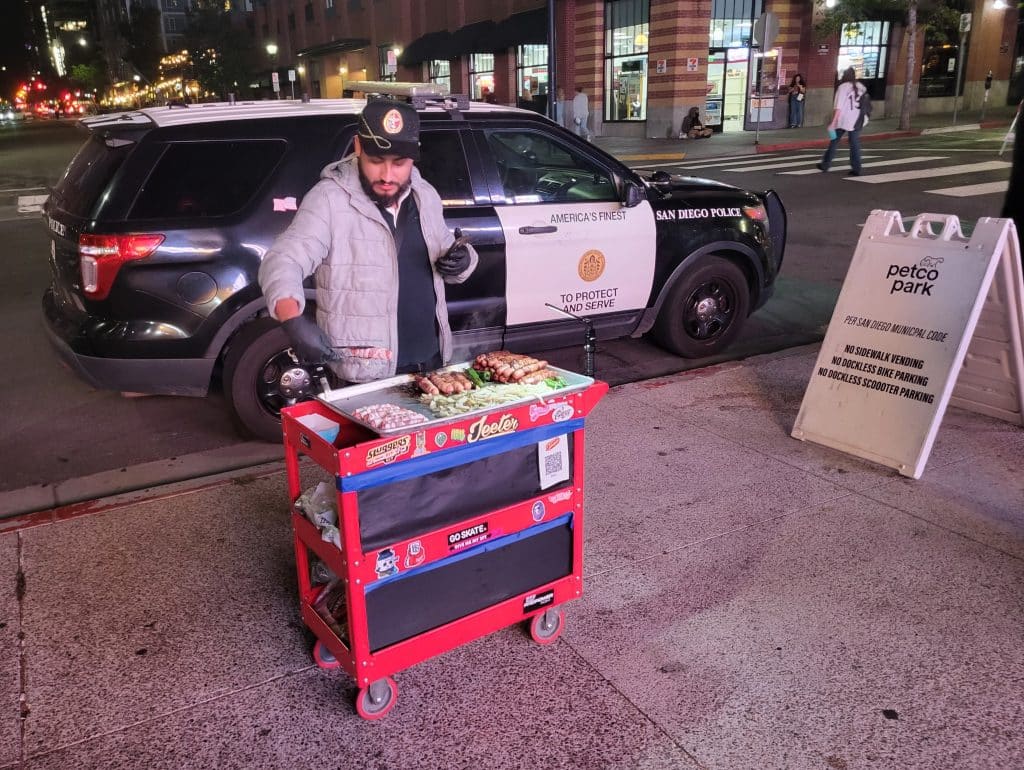
This disconnect has caused recurring problems. An organized syndicate of out-of-town hotdog vendors flaunt wavering enforcement efforts by the police department. The red carts are obvious public health and safety hazards. Stoic, mostly ungloved vendors don’t display permits or IDs. The wheeled carts have propane heated stoves and have no window guards to block the public from their product. Observers have said cart operators dump grease into city gutters. One cart caught fire. Cart vendors have been involved in fights.
The city is currently involved in court with one sidewalk food vendor. However, it’s not one of the red-cart invaders. It’s a case involving a vendor who’s been selling peanuts and popcorn near Petco Park practically since the San Diego Padres started playing there. This vendor has followed all the rules for decades, has all the required permits and is not selling hot food. Yet, he was recently ticketed and then had his inventory impounded by the police, including an envelope containing $1,200, he said.
Meanwhile, the red-cart bandits work the streets with impunity.
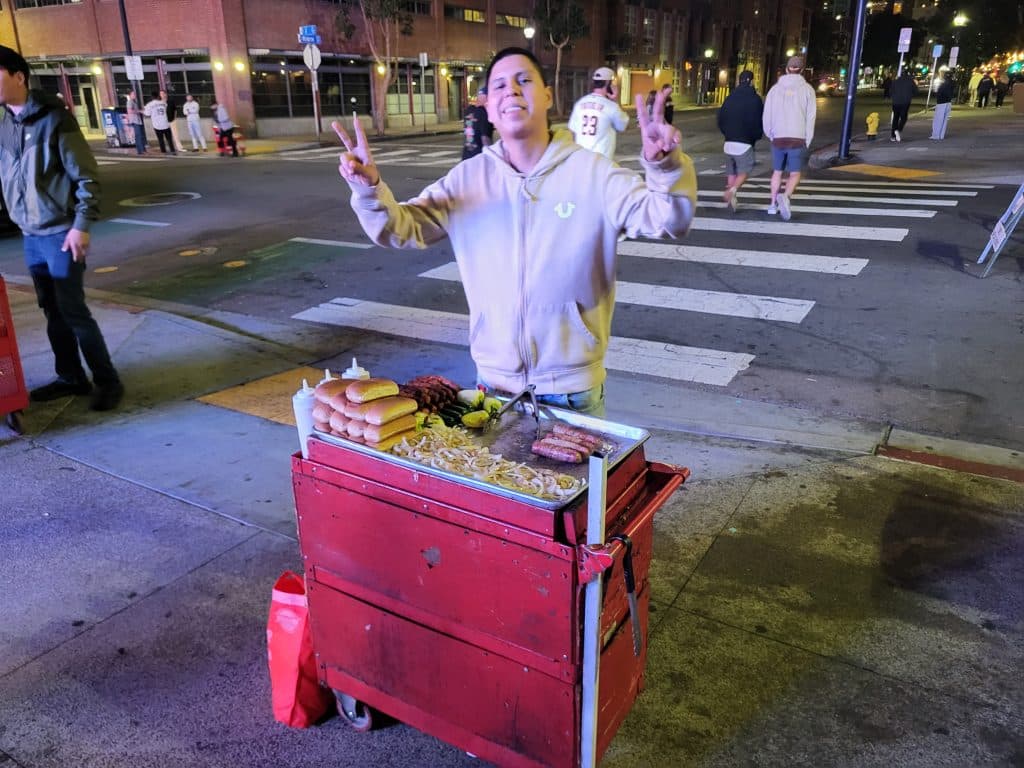
On Saturday, April 11, I went to the intersection of J Street and Ninth Avenue near a Petco Park exit. As the night Padres game was entering the eighth inning, four red carts were lined up along the curb there, less than 10 feet from each other.
Bookmarking both ends of the law-breaking line of carts were a pair of San Diego Police Department vehicles. Both cars were unmanned, one had its lights flashing. The presence of SDPD cars seemed to signal a tacit approval of the vendors, despite a sandwich sign right next to one cart that read: “NO SIDEWALK VENDING.”
The vendors wouldn’t answer questions like “Who do you work for?” or “Where is your ID?” Most of these vendors are tight-lipped, even though while I took photos, one smiled and posed, acting as if he felt immune to publicity or any police action.
The SDPD did not respond to questions from The San Diego Sun about current enforcement on illegal sidewalk food vendors.
Queries made to the office of San Diego Mayor Todd Gloria were fielded by City of San Diego Communications Department Director Nicole Darling.
“You are correct that the city is involved in active litigation,” Darling replied in an email. “We can not comment on specific lawsuits. I’d encourage you to contact the City Attorney’s Office but they will likely tell you the same thing.”
Gaslamp Quarter Association Executive Director Mike Trimble said the red-cart brigade first showed up in San Diego in July 2019 during Comic-Con International. That convention annually draws more than 130,000 people to the San Diego Convention Center.
It may be no coincidence that in 2018 the state of California passed SB 946 (Safe Sidewalk Vending Act). It decriminalized sidewalk vending and said local authorities can’t criminally prosecute vendors. SB 946 did allow municipalities to issue fines for violations based in part on health, safety and obstruction issues.
In March 2022, the city of San Diego wrote its own vendor ordinance. The following year, it shifted enforcement responsibility from a city division of code enforcement to the police department.
Trimble said since then enforcement by the SDPD has ebbed and flowed. There was some concern that San Diego’s ordinance didn’t dovetail with SB 949, so the city rewrote its ordinance again in 2024.
May of 2024 is when a dozen Gaslamp Quarter business owners sued the city for neglecting to enforce the local ordinance on the books. That suit is still pending.
Trimble has been having trouble getting attention from City Hall. Recall that he was highly vocal last year when the city quadrupled parking meter rates during special events. An October 2025 San Diego Sun story revealed that Trimble’s GQA and the mayor’s office had stopped communicating with each other. That disconnect arose from a disagreement over a decrease in city funding for the Fifth Avenue Promenade project in the Gaslamp Quarter.
At the time, representatives from the mayor’s office and from District 3 City Councilmember Stephen Whitburn’s office admitted they’d stopped going to GQA monthly meetings. Trimble says the communications link is broken to this day.
In light of not getting answers from the mayor’s office, Trimble has taken to issuing public statements. The topic now is the city’s alleged mishandling of rampant illegal vendor activity.
“The issue is no longer legal authority, it is consistent enforcement,” Trimble said. “The ordinance is in place. The findings were made. The time for action is now…California law still allows local enforcement based on health, safety, ADA access, sanitation and permit compliance.”
He says in the Gaslamp, the concerns are straightforward: blocked sidewalks, restricted emergency access, sanitation problems and public safety risks.
“SB 946 did not eliminate enforcement authority, it limited criminal penalties and requires local rules to be tied to objective health and safety concerns,” Trimble said.
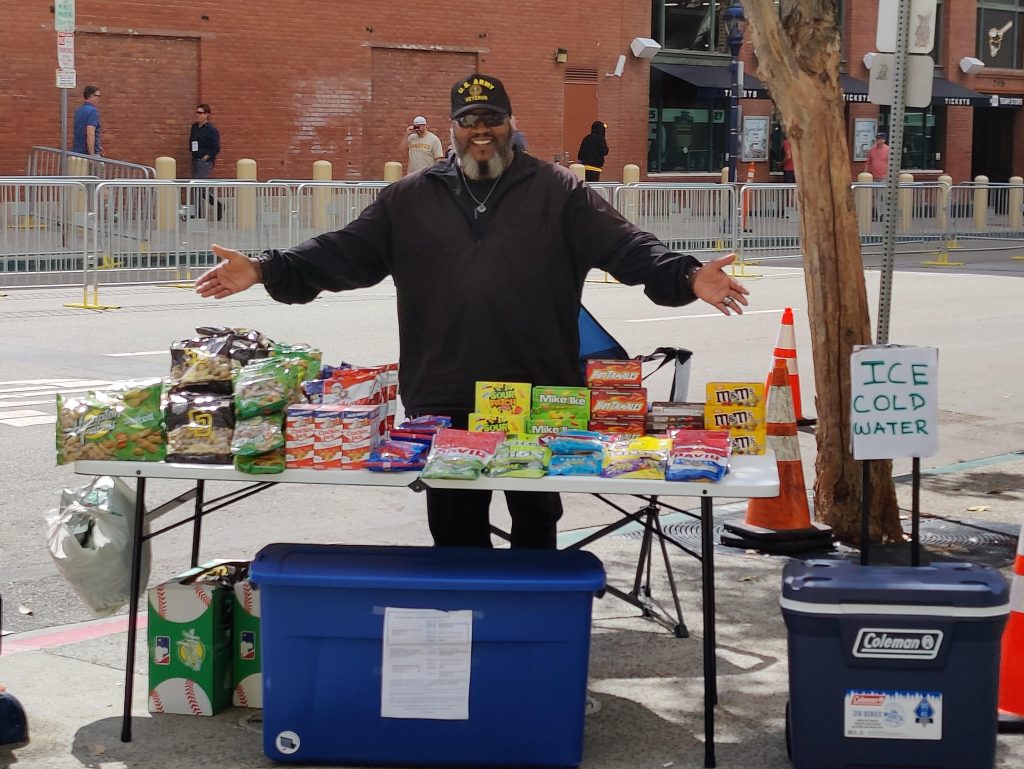
The vendor who’s in court with the city right now is named Imhotep Mustaqeem. He’s a veteran who’s been supporting his family by selling popcorn, peanuts, candy and bottled water in East Village since 2009.
Get this: Mustaqeem supports the Gaslamp Quarter business owners who sued the city over lack of enforcement.
“I support those business owners in the dispute with those propane-heating hotdog guys,” he said. “And I should not be lumped in with that group of rogue vendors. Those guys are health and safety issues. Not me.”
After the SDPD ticketed Mustaqeem twice and then impounded his inventory and his money, he sued the city. In San Diego Superior Court, a judge denied a motion for a preliminary injunction. In the California Court of Appeal, however, the interplay between state law and the city’s municipal code was noted.
The case is going back to a legal status conference on April 23, according to Mustaqueem’s lawyer Jeremiah Graham.
“The Appeal Court made it clear that the California law is enforceable in plain language,” Graham said. “You can’t be ticketed or have your things impounded just because you are a vendor.”
A vendor who is ignoring health, safety and other municipal codes can face enforcement fines. But that’s not happening in the city’s core.
“Downtown San Diego seems to be operating like the Wild West,” Carl Luna said.
A longtime pundit and Professor Emeritus for Political Science at San Diego Mesa College, Luna says he’s been visiting downtown since the late 1980s.
It’s an interesting conundrum,” he said. “The state says vendors have the right to try to make some capital so maybe they can move up and become a brick-and-mortar some day. But downtown is so frenetic these days, like Bourbon Street [in Louisiana], and these vendor carts feed into that.”
One vibe or another, the GQA’s Trimble wants official resolution.
“If current [legal] tools are insufficient, officials should say so publicly and identify exactly what changes are needed,” Trimble said. “Until then, responsibility for non-enforcement rests with local leadership.”
He believes the time for excuses has passed.
“The Gaslamp deserves better,” Trimble said. “The city has known about these conditions for years, and the longer this goes unaddressed, the greater the risk to public safety, public health, and the future of one of San Diego’s most important districts.” SDSun