Looking up from Imperial Avenue in East Village, the domed, steel-and-mesh latticework covering the upper floors of the San Diego Central Library outshines the rest of downtown’s corporate skyline. The nine-story building, however, is much more than an architectural wonder with million-dollar bay views:
- The central library is the only library in the nation that houses a high school.
- It holds a wealth of resources for job seekers and others in need of personal or professional services.
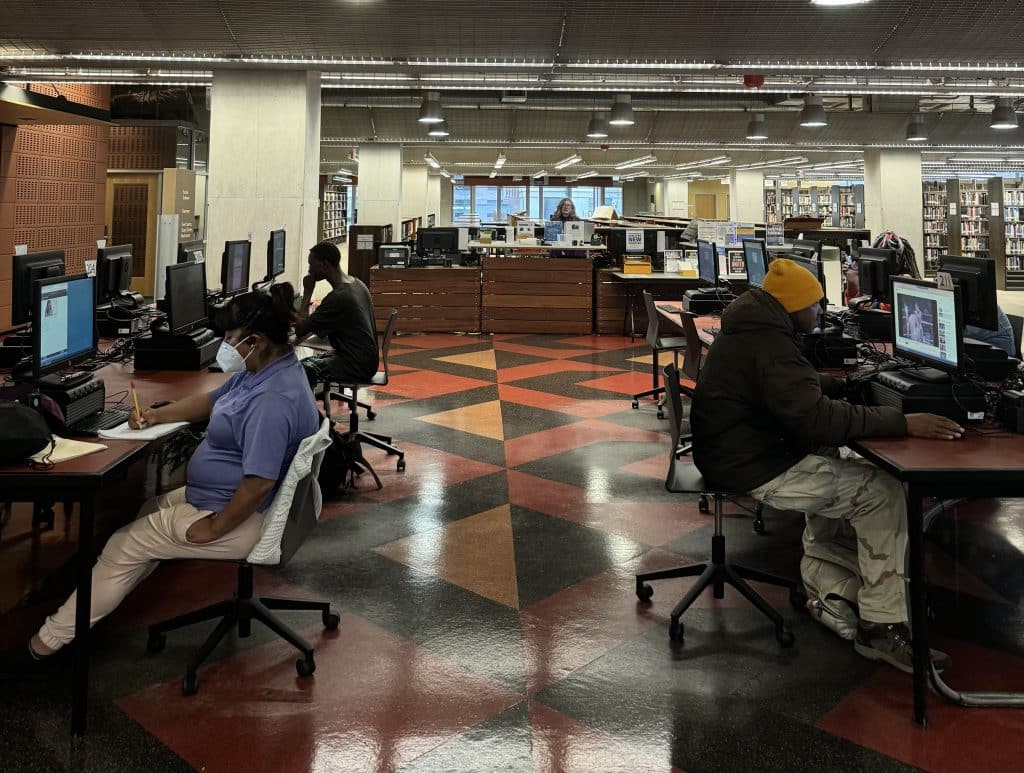
- And, like it or not, it’s used on a daily basis by downtown residents who make up part of the eighth-largest unsheltered population in the country.
The San Diego Public Library is currently working on a five-year tactical equity plan, prioritizing early literacy, accessibility and ADA needs, and outreach to residents who don’t use the library regularly in an effort to create awareness of benefits at all branches.
Chris LaMorena, a resident of southeast San Diego, recently visited the central library for the first time in a year. He came with his wife and daughter.
“We actually just started coming back because we needed to renew our library card,” LaMorena said. He uses the library for references and children’s books.
Yes, people do still come to the library for books–but it’s so much more today.
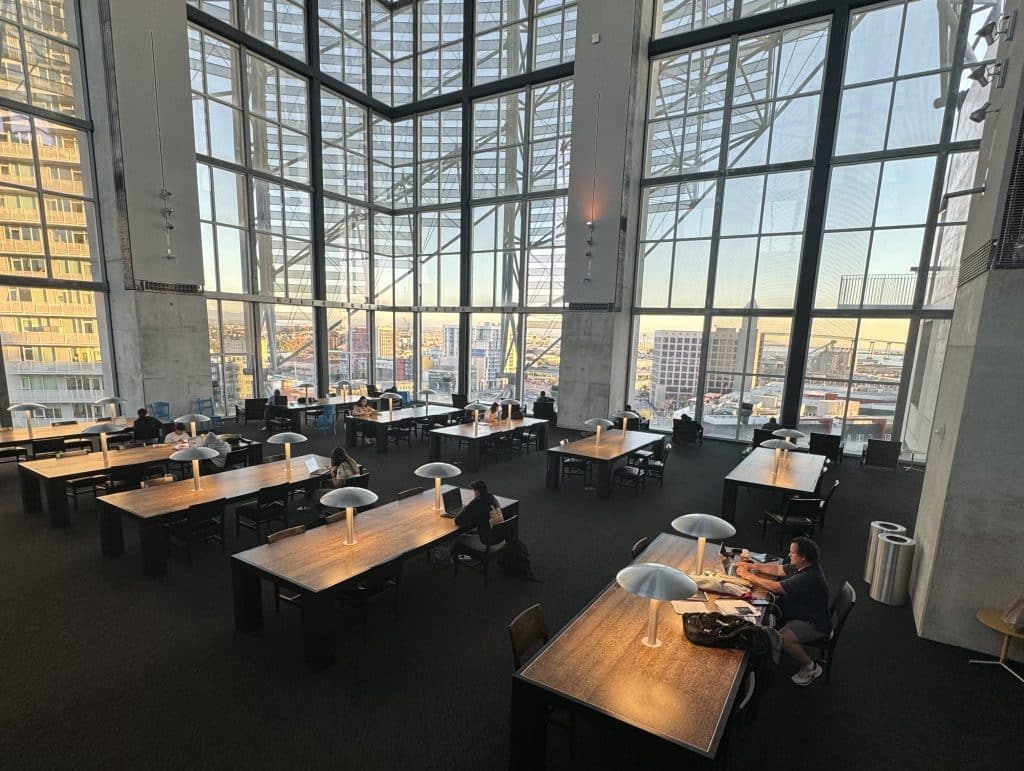
When you gaze out of its top-floor windows and see the Metropolitan Transit System headquarters, Petco Park, and the patchwork array of East Village streets chock full of economic inequality, it becomes obvious that the central library is a critical cornerstone of civic life.
“A public library can be a microcosm that’s reflective of the city,” the library’s deputy director of customer experience Jennifer Jenkins says.
The library recently celebrated its 10th anniversary. Jenkins previously worked as the supervising librarian, when she joined in 2015. Throughout her tenure, she’s seen the integration and development of several features and partnerships.
“We’re the great equalizer,” Jenkins says.
She’s referring to the central library’s provision of resources to patrons, which vary from floor to floor.
Each floor is organized by general interests and its complementary resources. Floor 3 has newspapers and periodicals, but also offers government documents. And an unexpected lifeline.
“When I could not find a bed in a homeless shelter, I got a bed here,” says East Village resident Fei Zhengxing, who was assisted in finding shelter after San Diego’s recent flash flooding. Beds are not available in the central library; a National Alliance in Mental Illness partnership with the library assists homeless patrons in finding shelter.
“Sometimes I use a computer because they are more powerful than my own cell phone,” Zhengxing adds. ”I glance at the magazines to take photos of the excellent publications.”
Zhengxing is a regular library patron. To her, it’s a symbol of “the beauty of America” because she was able to use one of its services, the third-floor Patent and Trademark Resource Center, to find her late father’s records.
James Andrews says he’s a homeless resident of East Village who comes to the library every day because the bathrooms are freely available to the public – a commodity hard to find throughout the rest of downtown. Andrews usually lounges on Floors 3 and 8, charging his phone, watching YouTube and answering emails while gazing out the window at the Coronado Bridge.
Floor 4 covers religion, philosophy and literature. You’ll also find the IDEA Lab (Innovate, Discover, Experience and Achieve) here. Patrons are able to access the lab’s variety of tools, like a 3D printer or audio transcription, without identification or applying for a library card.
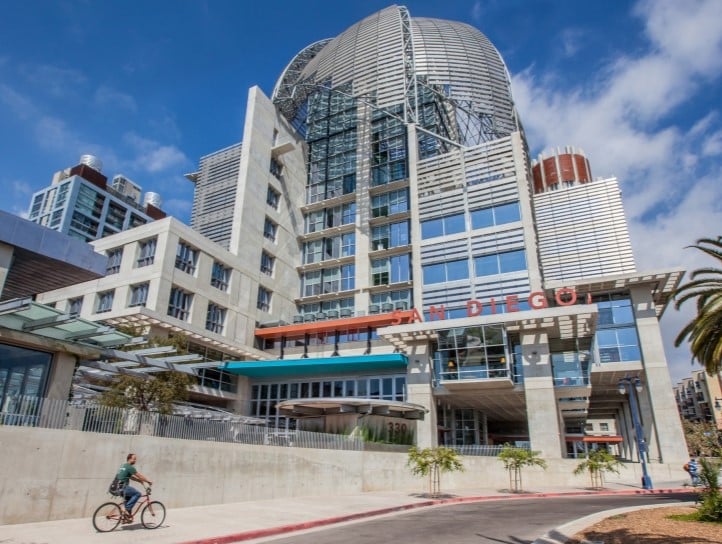
Award-winning architect Rob Wellington Quigley designed the library.
“Social choreography is at the core of my architectural thinking,” Quigley says. “And that has to do with activity seeing activity, people seeing people, so that the synergy of human interaction is reinforced.”
Per Quigley’s design, the San Diego Central Library’s layout allows for social immersion and adhesion while still necessitating the idea that its spaces are separate, without much hassle. Community is at the heart of its architecture.
Notably, San Diego Workforce Partnership’s location on Floor 5 has inadvertently become the program’s flagship location, despite other offices existing throughout Greater San Diego. The program offers one-to-one counseling with a case manager for anything from job searches to resume building and interview preparedness. Currently, there is a waitlist for case managers through early summer.
Specialization with Veterans Affairs is also available. Veterans and families of veterans are able to get help accessing benefits or support re-entering the workforce.
Down the hall, programs like READ/San Diego are also available for helping increase adult literacy rates. According to the READ/San Diego website, approximately 560,000 adults in San Diego cannot read and write well enough to pursue professional and personal needs.
e3 Civic High School is a charter high school located on Floors 6 and 7. Students have access to the library’s more-than 5.3 million books and various programs. The high school is not open to the public, though there are common areas on other floors where students mix with library patrons after school.
In the past, there have been concerns about interaction between the homeless population and e3 students.
There was a shooting in the library’s courtyard last year, and police calls are a regular occurrence.
In recent years, the budget has been expanded to add more security guards, who are trained to carry naloxone, a medical device used to treat opioid overdoses.
Safety remains a challenging issue.
In 2023 during PRIDE Month, two individuals checked all the LGBTQ materials out of the suburban Rancho Peñasquitos branch of the library system. It garnered national attention.
Outside that incident, San Diego hasn’t faced any major attempts at book-banning, which tend to target authors and titles of works that focus on Black, Indigenous, people of color or LGBTQ issues.
Rather, the San Diego Library System participates in the Books Unbanned program. Teens and young adults ages 12 to 26 can access San Diego Public Library’s online collection of banned or restricted eBooks and eAudiobooks. It’s a free service.
Books Unbanned is a project Jenkins brought to fruition through collaboration with other public libraries nationwide.
Jenkins left her home library system in South Carolina because she felt the local board and municipal leadership was actively participating in censorship. To Jenkins, intellectual freedom is critical, important and essential to democracy.
“We’ve gotten really cool comments and feedback from folks who are grateful to access these titles somewhere,” Jenkins says. “We’re hoping to grow that program and make more titles available. We don’t dictate what people read, we provide access.”
The Books Unbanned collection and initiative is funded through private donations, like many other services and programs in the library.
Community input has always been pivotal for the library. During the initial consultation process for its creation, it was community input that dictated the addition of the expansive Floor 8 reading room.
Quigley says: “One of the most brilliant ideas that came out of that workshop process was ‘We can’t afford to go to the top of the highrise and eat dinner at the restaurant. We certainly can’t afford to live in the penthouse.’”
He says the library should be a penthouse for the people.
There’s no other library in the country, or even in the world, that has so many public amenities on the rooftop. They’re always on the ground where they’re more easily accessible, where it “makes more sense,” Quigley says.
Quigley’s design — influenced by his touring of foreign libraries and how, he says, their facilities lack homelessness due to a stronger social net — emphasizes the profound role the central library plays in places where more direct governmental support is needed.
The central library draws attention to East Village in the physical sense. The symbolism of the extent and role in which local government should play in addressing social welfare and civic duty is not lost.
“This was a building that was large enough and civic enough that it could make a difference in reorienting downtown to the southern areas,” Quigley says. “East Village is the back of downtown. It ought to be the front.” SDSun