
The San Diego Sun recently interviewed the two candidates facing off in the general election for the District 3 City Council seat. Incumbent Stephen Whitburn and challenger Coleen Cusack were both asked similar questions about themselves, each other and the city’s top hot button issue of homelessness. Whitburn’s story is here; Cusack’s piece ran on October 4.
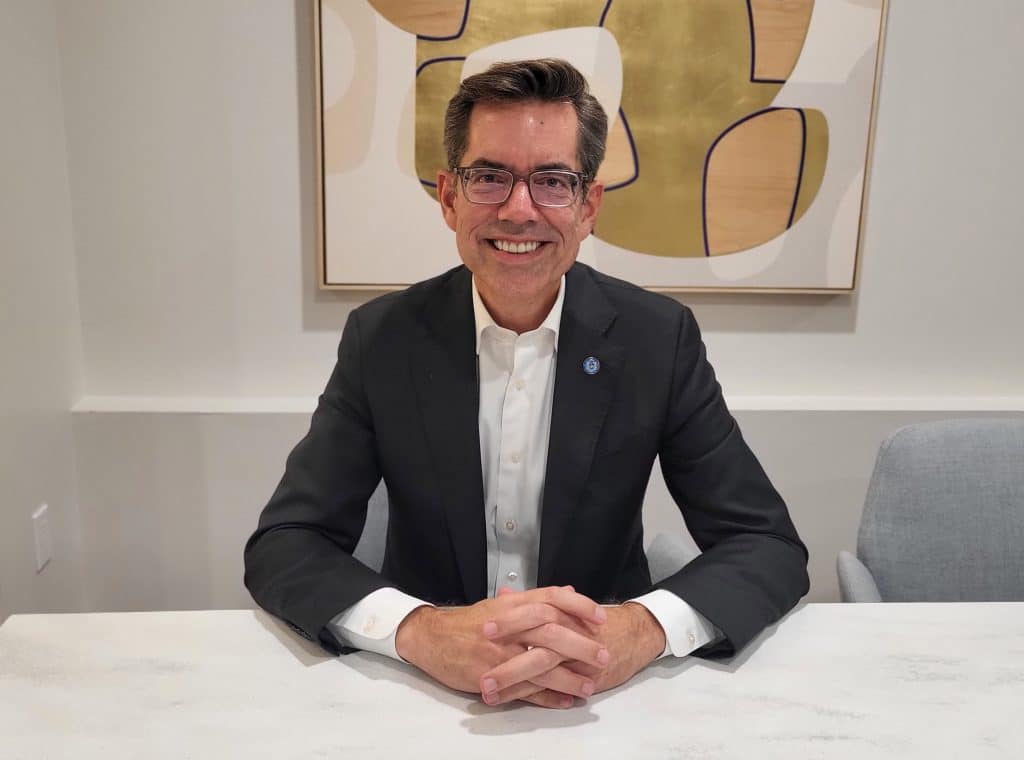
As is usually the case, downtown’s city councilmember Stephen Whitburn is tidily dressed in a fitted suit. It’s a Monday evening, after a council meeting has wrapped up, so the after-work casual look is sans tie.
The child of parents prone to travel, Whitburn was born in West Germany, pre-dismantling of The Berlin Wall. His father was a college professor, who moved the family from city to city for various campus teaching jobs. Whitburn eventually landed at the University of Wisconsin (Madison), majoring in Spanish Language and Latin American studies.
After graduation, he stayed in Madison, working as a radio news journalist. In the dead of one particularly frigid Wisconsin winter, Whitburn decided moving to warmer climes was logical. He researched 333 metropolitan areas and wound up in San Diego in 2000.
After finding a job here in news radio, he subsequently worked for the American Red Cross, San Diego Pride and the American Cancer Society. Whitburn sought political office and lost races for San Diego City Council in District 3 (2008) and the County Board of Supervisors (2010). He won the city’s D3 seat in 2020.
The first time Whiburn saw homelessness up close was when his family lived in Albany, New York. On treks to New York City he encountered people living on the street.
His reaction: “It was tragic. Tragic and sad.”
On arrival in San Diego, Whitburn wasn’t met with the homelessness problem that exists today.
“Typically, you saw people panhandling either in front of the convenience store or along the freeway ramps,” he says. “I don’t recall seeing a lot of encampments 24 years ago.”
He doesn’t recall homelessness being at the top of the list of issues in his 2008 or 2010 political races. “But yes, at that point there were people living outdoors,” he says.
According to the 2023 WeAllCount Point-in-Time Count, the number of people experiencing homelessness in San Diego County was more than 10,000. Roughly half were living in shelters or some type of transitional housing; half were unsheltered and living on the streets.
During the last two years, the count of people experiencing homelessness for the first time versus those who were housed rose every month, according to the San Diego’s Regional Task Force on Homelessness. The city is losing the battle on that front.
Whitburn claims the city council and San Diego Mayor Todd Gloria have actively sought to add to the city’s list of shelters. His D3 election opponent, Coleen Cusack, points to roughly a net loss of 900 shelter beds coming up later in the year.
Numerically, on face value, that loss could have been recouped by a mayoral plan, backed by Whitburn, to convert a facility at Kettner and Vine to a 1,000-bed Mega Shelter.
The Mega Shelter proposal has been fraught with issues. Opponents say 1,000 homeless people in a 60,000 square foot facility is too dense; that the location is in a dangerous traffic spot; the site is possibly on contaminated land; and the real estate deal is wildly lopsided against the city.
Now it appears a council vote on the Mega Shelter will not happen before the November 5 general election, Whitburn says.
Though he says the deal is flawed and could be renegotiated, Whitburn says he’d vote for it today if it came before the city council.
“There are a thousand people living on the streets today that could be off the streets and in a safer and healthier place if we had a thousand more shelter beds,” Whitburn says.

Last week, the city passed a short-term action plan on homelessness, Whitburn points out. That calls for, among other options, an expansion of the number of tents available at two outdoor safe sleeping sites (at 20th and B, and a Balboa Park spot dubbed the O Lot).
The plan calls for adding a combined 235 tents to both sites, bringing the grand total to 767 tents.
Cusack calls living conditions at the tent cities deplorable and “Third World.” On October 4, she held a press conference decrying a rat infestation at the O Lot. A city spokesperson called it an isolated incident.
Cusack says health and safety issues must be addressed now, before more tents are added.
“It’s not housing,” Whitburn admits. “The ultimate goal is to get people into permanent housing. In the meantime, we need a place that is better than an encampment on the sidewalk. And there is no question that the safe sleeping sites are better than an encampment on a sidewalk.”
He notes the safe sleeping sites have security, bathrooms, showers, laundry, meals and connections to services.
“It is objectively a safer and healthier place than an encampment on the street,”Whitburn reiterates. “No reasonable person in San Diego is arguing that living in an encampment on the sidewalk is better than our safe sleeping sites. This is backed up by the fact that there is a waiting list of about 300 people.”
Those safe sleeping sites came into existence after the mayor (backed by Whitburn in a 5-4 council vote) enacted a camping ban on city streets.
Whitburn points to monthly numbers provided by the Downtown San Diego Partnership to show the camping ban was a success. In May 2023, the Partnership counted 2,104 people living outdoors downtown. In August 2024, that number was down to 856.
Yes, that’s a 60% drop. Encampments have largely been dispersed, but individual tents are still visible in East Village and other downtown adjacent neighborhoods. Is the city camping ban a win if many homeless folks now set up tents outside the downtown fence above Interstate 5, moved to other suburban neighborhoods or set up in San Diego river beds?
“Many of the people who left downtown have gone into safe sleeping sites and shelters,” Whitburn says. “Yes, there are people along the freeway and the freeway ramp but it’s nowhere near the number of people who’ve left downtown streets.”
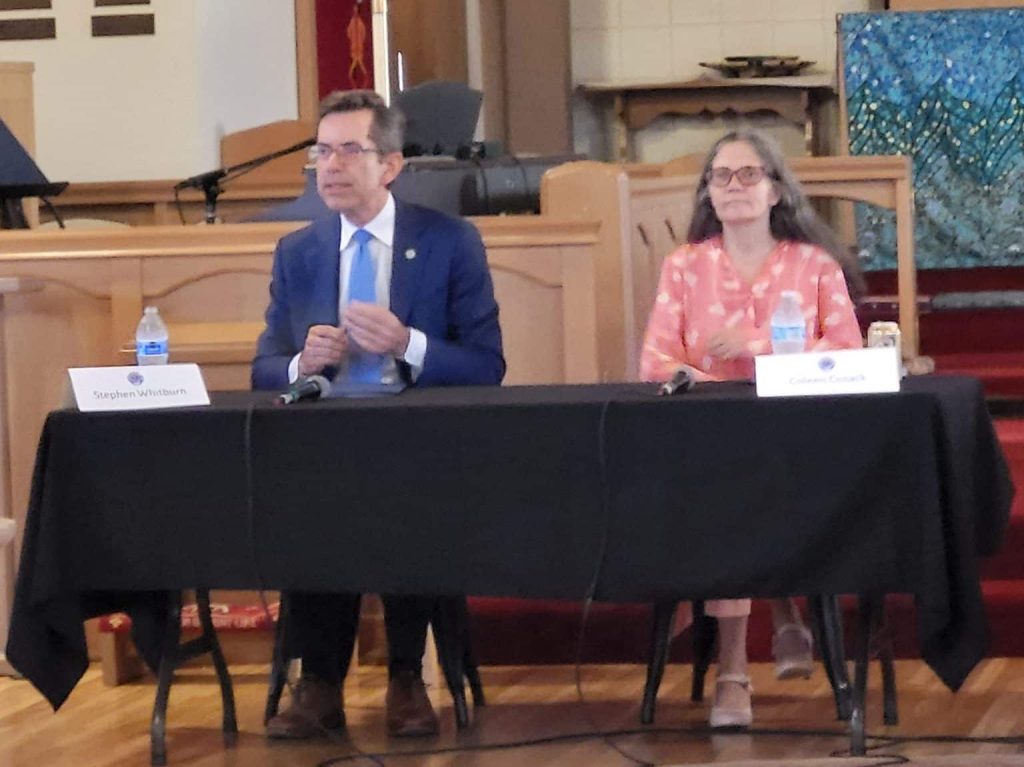
On homelessness and other city policies, a complaint by Cusack and others is that Whitburn marches in lockstep with the mayor.
“I make my own decisions on policy,” Whitburn says. “If they happen to be consistent with what the mayor is advocating for or what any of my colleagues are advocating for, then that’s fine. But I vote on matters the way I see them.”
Asked to compare demeanors between himself and his opponent, Whitburn initially declines.
“I don’t really judge people by their demeanor and I don’t have a particular desire to characterize my opponent’s demeanor,” he says.
Later, Whitburn notes that Cusack has a “right to be outspoken.”
Cusack regularly shares flaming opinions publicly, especially on social media.
“I try to be thoughtful and work toward practical solutions and build consensus where possible,” Whitburn says. “I think the easiest thing to do in politics is to be a chronic naysayer. My opponent is a chronic naysayer. She opposes everything, and she offers no realistic alternative solutions.”
One thing the two have in common: Whoever wins will be the latest D3 council member who’s a member of the LGBTQ community. The streak dates back to 1994. Whitburn is gay. Cusack says she is bisexual and an early adopter of polyamory.
From a numbers standpoint, Whitburn seems to be the favorite to win reelection. He beat Cusack in the four-person March primary, 52.39% to 20.95%. Both are Democrats, though Whitburn has locked up most of the party’s organizational endorsements. Cusack seemingly got a boost in the primary when she was endorsed by The San Diego Union-Tribune.
Cusack says Whitburn has the funding to do polling and says the fact he won’t reveal the results of a recent poll points to her doing better than expected.
Whitburn admits he’s done polling, but says “the polling is internal to the campaign, and that’s where it’s going to stay.” SDSun
California mail-in voting is underway. General Election day is November 5. For more information go to: VOTE SAN DIEGO.