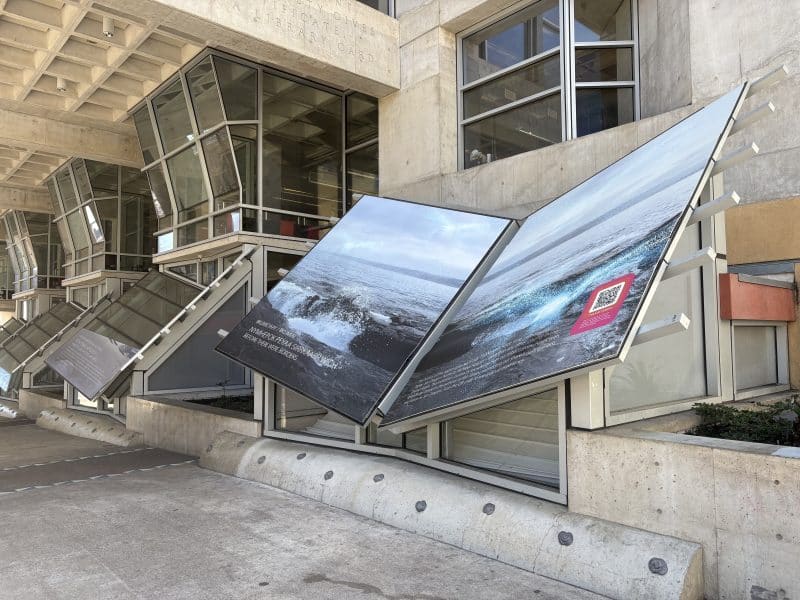

Kudos to a scrappy group who dodged budget-related barriers and delivered a much-needed reimagination plan for the City of San Diego’s aging City Hall complex.
This wasn’t a group of politicians, civic leaders or highly paid professional design consultants.
Meet the Architecture 302 Urban Design Studio, a team of University of San Diego students.
Led by USD Lecturer Megan Groth, a group of nine undergrads produced an exhibit called Designing Civicness which was from a report called “Urban Repair Manual: San Diego Civic Center.”
It was a class project based on a real-life issue that garnered plenty of attention.
The class was all set to display its work last week on the first-floor lobby gallery of City Hall. Then the bad news: San Diego Mayor Todd Gloria announced a package of emergency budget cuts. On the cutting board: The Civic Center Revitalization effort.
USD’s City Hall display was cancelled. Seems it’s politically incorrect to show off design plans in an era of austerity.
USD’s Groth, however, was undeterred. She made a call. The display got a one-day-only showing a week later across the street from City Hall in the lobby of Gensler, a global architecture firm.
It was a happy ending, but one with plenty to unpack.
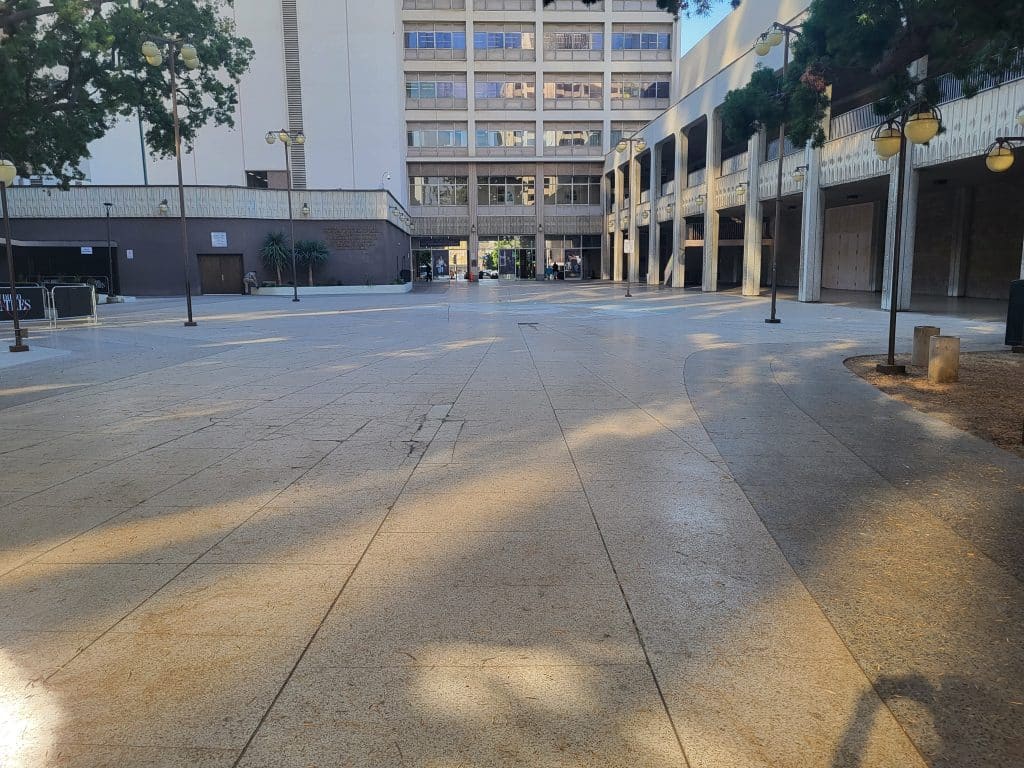
Before the November 2024 election, Mayor Gloria had promoted his once-in-a-generation plan to transform the city’s municipal core. That core includes the City Administration Building (City Hall), the Civic Theatre, Golden Hall, a public plaza, the Civic Center Plaza office tower and a parking garage (all bound by A and C streets and First and Third avenues) as well as the infamous 101 Ash Street building.
The parcel was put up for sale. No takers.
Next, a volunteer group of 30 local civic leaders and stakeholders spent six months producing a high-minded, broad-stroked “manifesto” for development of the land.
Problem: Mayor Gloria had anticipated the passage of Measure E in the November General Election. The one-cent-sales tax increase lost on the ballot, sending Gloria scrambling to cut city services, including The Civic Center Revitalization plan.
In an unusual twist, one part of the effort is still moving forward. With a primary goal of preserving the Civic Theatre, the Prebys Foundation hired U3 Advisors, overseen by the Downtown San Diego Partnership (DSDP), to create a vision for the area.
Because the Prebys Foundation’s funding is a charitable donation, that money doesn’t affect the city budget.
Unrelated to the Prebys Foundation donation, DSDP President and CEO Betsy Brennan was on hand for the USD student presentation in the Gensler lobby. The students’ Urban Repair Manual” class project is also not sanctioned by the city. However, an impressed Brennan noted she “found kernels of important work” in their presentation.
The students were tasked with reimagining the interior space of the Civic Center, primarily the Civic Plaza and Plaza-facing walls of buildings like Golden Hall and City Hall.
Nine students: Peter Contreras, Pape Faye, Emma Jiminez, Jim Kirkwood, Victoria Lopez, Alexander Pai, Estevan Paredes, Alison Pluemer and Reid Willens made nine suggestions on ways to upgrade the Civic Plaza.
Suggestions included building an iconic facade, creating seating areas and building a raised platform in the middle of the plaza.
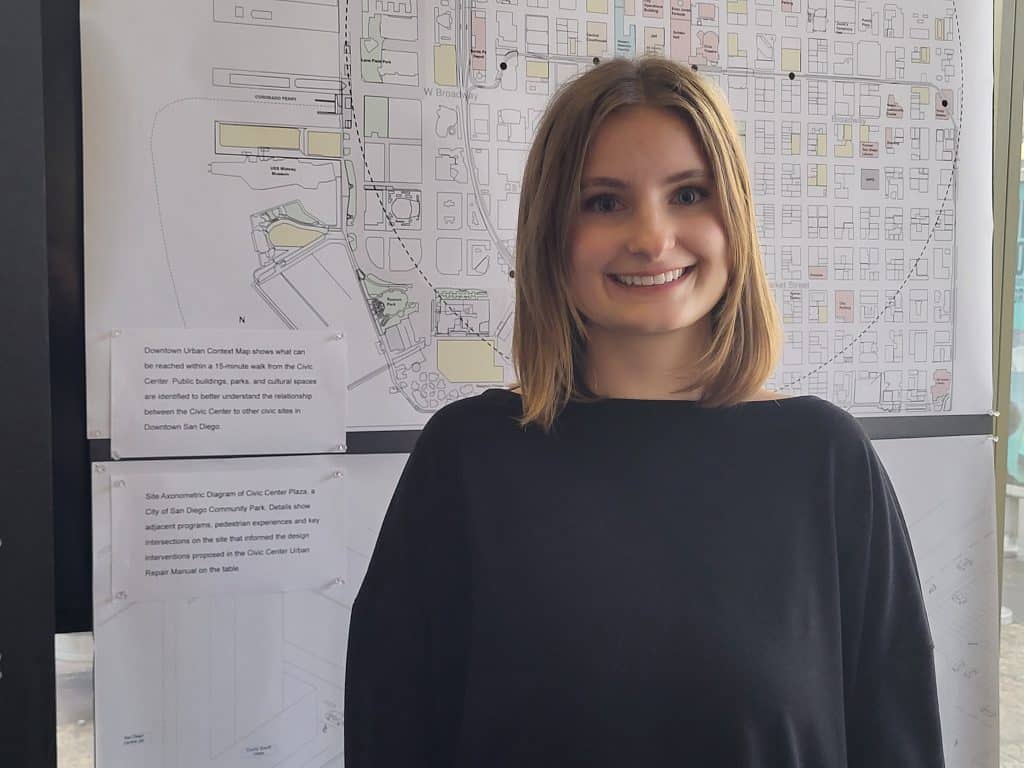
“We spent a lot of time on the site, measuring things and taking pictures,” says USD student Pluemer. “We found out the night before that our exhibition was cancelled because Measure E didn’t pass. But even though this was a school project we decided to treat it like we were a team of architects…Yes, our ideas might not come to fruition, but it was important for us to act like professionals in the field.”
Along with Brennan, others gathered to hear the presentation included a representative from the mayor’s office and several local architects. Positive comments about the report were mixed with derisive observations of City Hall, which was built in 1965 and has never been refurbished.
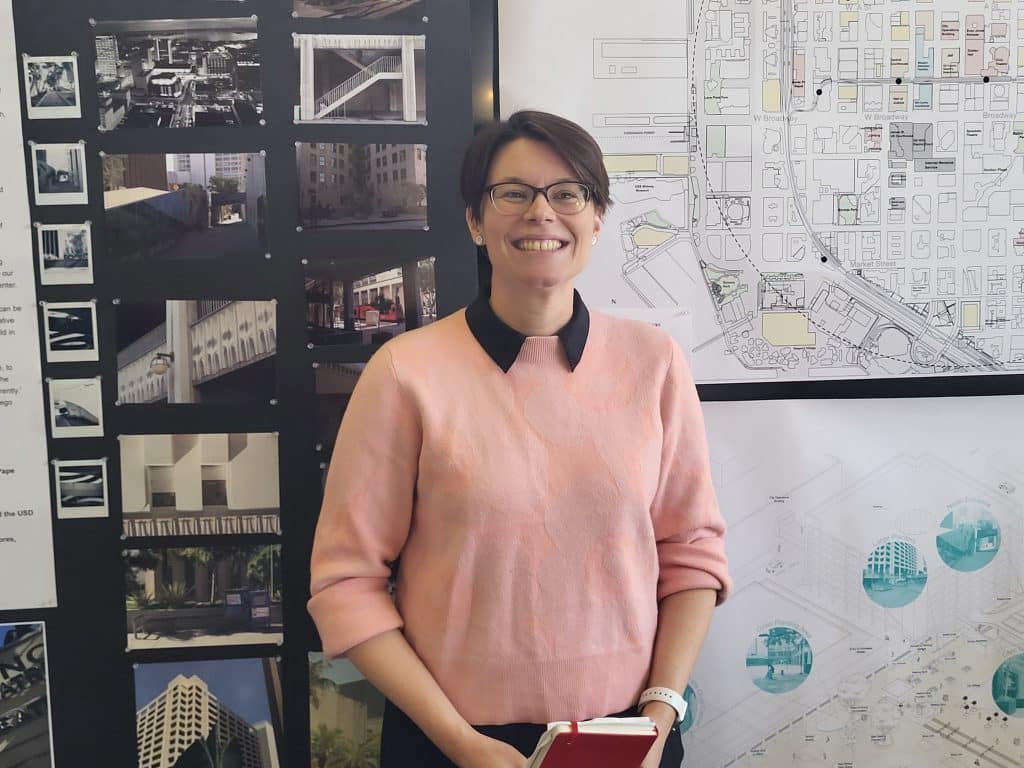
Groth was beaming with pride after her students presented their Urban Repair Manual.
Now a USD lecturer, Groth is a self-employed architect who taught for five years at the former Woodbury University School of Architecture in Barrio Logan. She was also on the Design Commission for the City of Seattle and is the author of guidebook Places We Love: San Diego Tijuana.
She says over the course of the year, various students visited the Civic Center and compared it to important civic spaces around the world. She says one student summed up the group feeling about The Civic Plaza with the observation: “This is not a place for people.”
Groth also commends her students for making suggestions that don’t just call for demolishing things as much as looking at how to repair certain spaces.
The mayor says the Civic Center Revitalization plan is dead for now. If or when the city does get its fiscal ducks in a row, USD does have nine would-be architects seemingly with shovel-ready experience. SDSun