Whenever my husband sails into Naval Base San Diego, there’s a good chance you’ll find me on Shelter Island, scanning the horizon.
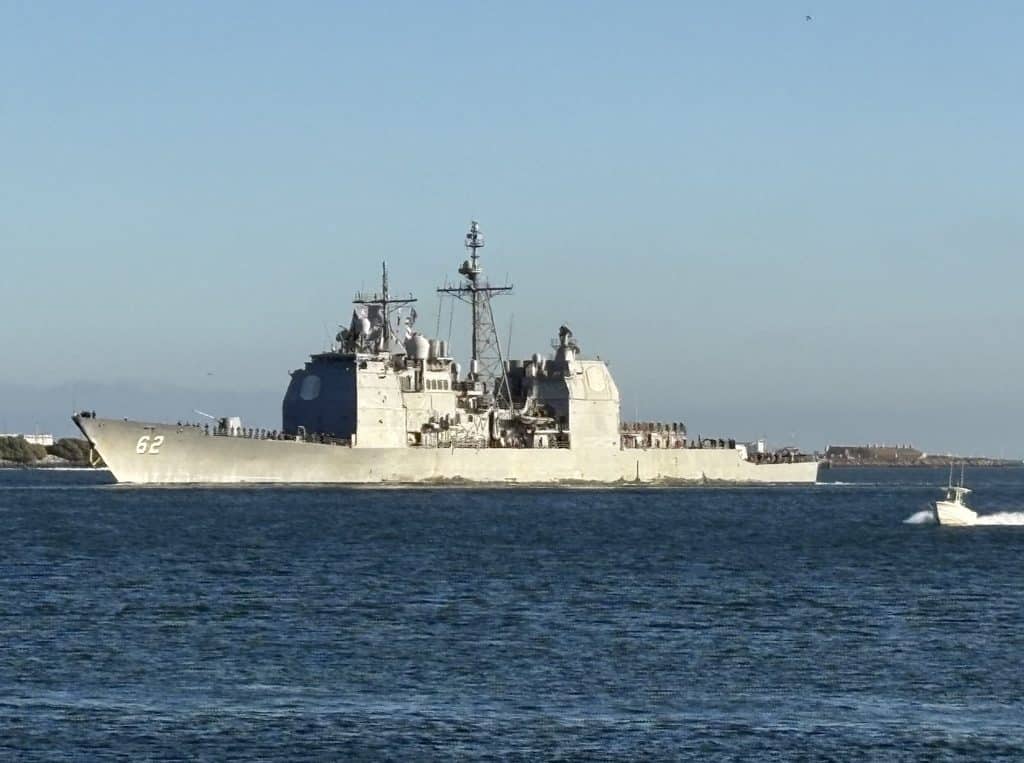
Oct. 9 was a little different. The aircraft carrier USS Abraham Lincoln arrived the day before, with much fanfare. The USS Robert Smalls (CG 62), a U.S. Navy guided-missile cruiser arrived in San Diego not just for a port visit or to conclude a deployment, but to establish its new home port after more than a decade stationed in Yokosuka, Japan. One of the sailors aboard was my husband.
I made my way along Shelter Island’s mile-long waterfront, where the walking path offers sweeping views of San Diego Bay, Naval Air Station North Island and ships passing between the Pacific Ocean and the naval installation farther south.
It’s a familiar walk for me. I’ve written about Shelter Island before, but this time I’m less interested in the island itself than in what’s approaching it.
A ship with a remarkable namesake. The USS Robert Smalls has a history that stretches back decades, though it’s carried its current name only a few years.
Commissioned in 1989, the ship was originally named USS Chancellorsville, commemorating a Confederate victory during the American Civil War.
In February 2023, the Navy announced that the ship would be renamed following recommendations from a commission tasked with identifying military assets that honored the Confederacy.
Its new namesake, Robert Smalls, has an extraordinary story.
Born into slavery in South Carolina in 1839, Smalls became a skilled mariner, familiar with the waterways around Charleston. During the Civil War, he was assigned to a Confederate transport vessel called the Planter.
In May 1862, Smalls seized an opportunity to escape. With Confederate officers ashore, he commandeered the vessel, brought his family and other enslaved people aboard, and navigated through Confederate defenses before surrendering the ship to Union forces.
His courage secured freedom for those aboard and delivered a valuable vessel and military intelligence to the Union.
But his story didn’t end there. Smalls went on to serve the Union war effort, advocate for civil rights and represent South Carolina in the U.S. House of Representatives for five terms.
More than 160 years after his daring escape, his name now sails aboard a U.S. Navy warship.
From Japan to San Diego. For more than a decade, this cruiser was part of the U.S. Navy’s forward-deployed forces in Japan.
Unlike ships that operate from American ports and travel overseas for deployments lasting several months, forward-deployed ships are stationed abroad, closer to the regions where they’re expected to operate.
Yokosuka, located south of Tokyo, is one of the Navy’s most important overseas installations. Keeping ships there allows the United States to maintain a presence in the Indo-Pacific and respond more quickly to developments across the region.
Homeport changes are part of how the Navy rotates its fleet, balancing operational requirements, ship maintenance and the introduction of newer vessels.
The USS Robert Smalls departed Yokosuka on September 26. It was the last U.S. Navy cruiser stationed there, and its departure marked the end of an era. The guided-missile destroyer USS Mustin has taken its place.
For the sailors aboard Robert Smalls, San Diego now becomes home.
And for the ship itself, this may be one of its final chapters. The cruiser is expected to be decommissioned in 2027, after nearly four decades of service.
A waterfront shaped by the Navy. Walking along Shelter Island, it’s difficult to overlook the Navy’s presence in San Diego.
Across the water is Naval Air Station North Island, where aircraft carriers and naval aircraft are familiar sights. Along Point Loma are naval facilities supporting submarines and other maritime operations. Farther south, Naval Base San Diego serves as home port to dozens of surface ships.
From the end of Shelter Island, it’s possible to appreciate the variety of vessels that call San Diego home. Aircraft carriers, destroyers, cruisers, submarines and amphibious ships all have different missions, capabilities and distinctive silhouettes.
The USS Robert Smalls is a Ticonderoga-class guided-missile cruiser, a type of warship designed primarily to provide air defense for naval forces, including carrier strike groups. At approximately 567 feet long, it’s considerably smaller than an aircraft carrier, but still an imposing sight as it moves through the bay.
For visitors, watching a naval vessel enter San Diego Bay can be an impressive spectacle. For the sailors aboard, and the families waiting ashore, it means something entirely different. With my husband back in San Diego, I feel a weight has been lifted. There’s a sense of peace that he’s out of harm’s way, at least for now. SDSun
Award-winning columnist Deanna Ratnikova is the creator of The GO Deck – grab a deck today and be inspired to Get Outdoors and GO on new adventures.