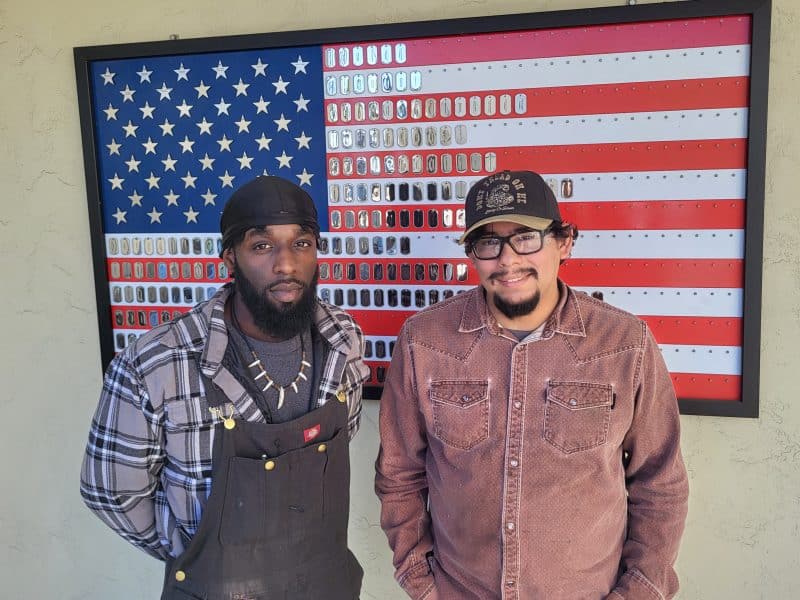
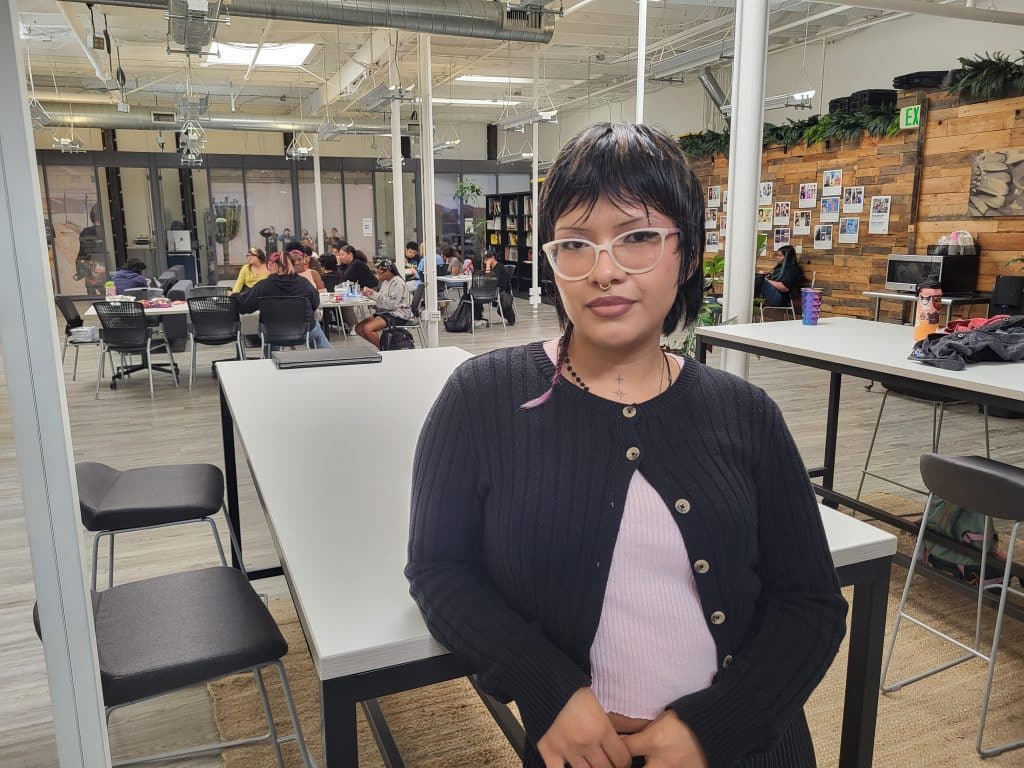
JC Núñez grew up in Barrio Logan two blocks from the current site of Outside The Lens. Now 26, Núñez recalls commuting past the nondescript building on 14th Street, never imagining she’d teach there one day. Or, be part of such a truly special place.
Outside The Lens is a unique nonprofit school for media arts. Twenty-five years ago, Elisa Thomson founded OTL with a vision to empower young people to tell their stories through photography. Thomson’s initial grassroots project was to give refugee and immigrant youths disposable cameras to capture their experiences. The results were moving visuals from the frontlines of poverty and despair.
On a recent Wednesday afternoon, Núñez is preparing to teach the weekly Media Arts Studio program.
“This is a free-form, very low-commitment space,” Núñez says. “It’s for students to come and explore their creativity. And evolve their artistry. I love creating art. I think of myself as an artist, although I’m shy about sharing what I create. I forward that into uplifting our students. To make sure they feel safe to explore whatever it is they want. Our program really is a small-knit community. We ask them what they want to eat and we feed them every week. We also ask what they want to do. We do surveys to update our curriculum. Then we buy materials.”
OTL’s indoor space is a high-ceilinged warehouse. Walls are adorned with student projects. There are a few glass-walled offices and a pair of breakout classrooms. This could easily be office space for a tech start-up, minus the distinct banter of teens.
“All of us come from very similar low-income backgrounds,” Núñez says. “We felt like we needed a space like this when we were in high school. We would have all evolved a lot faster. We pour all of what we would have wanted in our teenage years into this program.”
Nearly 20 kids have arrived by the time Media Arts Studio is scheduled to start. A few more teens will trickle in later. Most take the trolley to get here.
“The turnout every week speaks for itself,” Núñez says. “If we were stricter, if we had a lot of rules, and had a more authoritarian way, I don’t think we would have so many teens showing up. When I was younger you had to sign up for these kinds of things and you had to be on a waitlist. We don’t do that. We welcome everybody with open arms. We don’t ask any questions if they don’t come back. Life happens. If you want to come back in a month or three months, that’s great.”
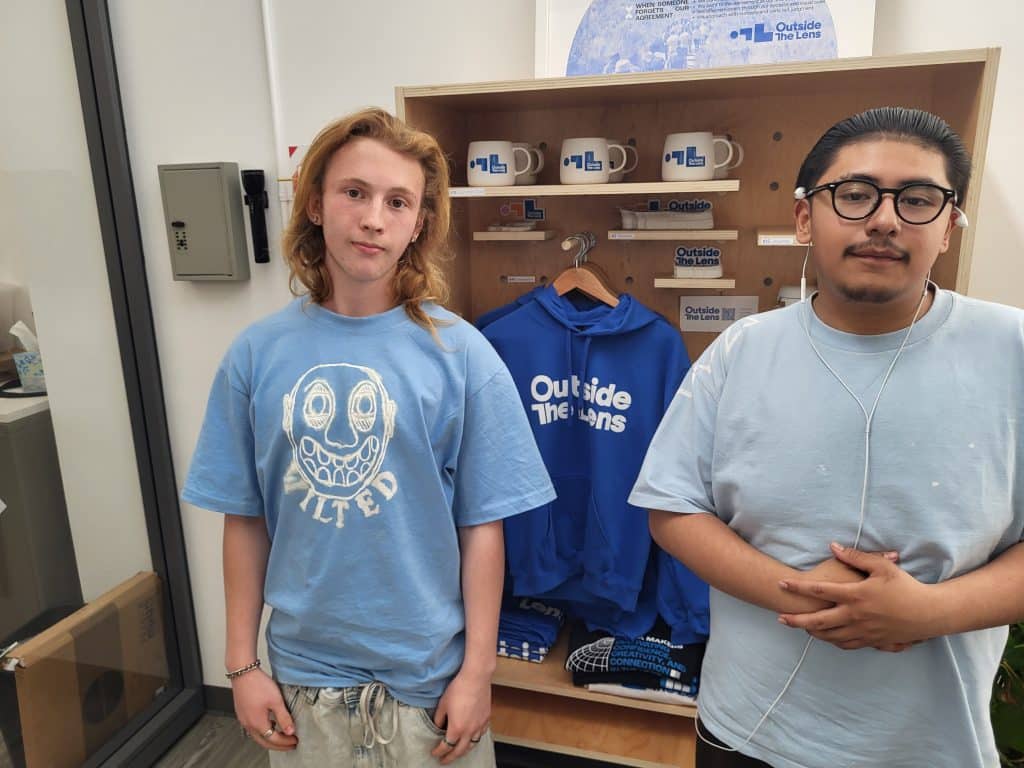
Michael Crane and Carlos Guzman, friends and juniors at San Diego High School, are creating designer clothing. For now there’s no overhead. Customers give them their pants and shirts and the boys stylize the clothes. They want to formally create a business.
Both come to OTL every week.
“I was looking for a community,” Guzman says. “People like me, who could give me advice on how to improve my things. Workshops to improve my work. They’re helping me with marketing strategies. Teachers here talk about digital e-commerce.”
Crane is also all in with OTL. “I look forward to it every week,” he says. “It’s given me an opportunity to make art and have all the supplies that maybe I wouldn’t have at home. The food is good, too.”
Cristiana McCarther is a student at Monarch School. The 17-year-old was homeless for the last four years. She beams when she says she and her mom and five siblings were housed last week. Their place is just an eight-minute walk from OTL.
She likes watercolor and pencil drawing and is giving photography a try. “This is me trying something different,” McCarther says. “It’s a big opportunity. We’re going to create portfolios. It could really get me somewhere else. Maybe a career.”
Leo Janolino exudes a quiet confidence. He’s 17 and has been attending Lincoln High School since moving to the United States from the Philippines three years ago. He prefers a combination of traditional and digital art. OTL has given him access to software like Affinity, Canva, Adobe and more.
“I’ve had a lot of projects in my mind for the past three years,” Janolino says. “Now I can work on them all.”
Edie Ramirez beams when she talks about her project. The 19-year-old San Diego City College student is planning a photography display based on the women in her family, including her mom, a pair of tias and her grandma.
“I’m getting tips and advice on photography here, and they’re teaching me to use lighting and filters,” Ramirez says. She uses a state-of-the art Canon, an upgrade from her previous equipment. “Before I came here I had been using my mother’s rundown Canon camera from the 1990s. It was so old the camera battery would fall out.”
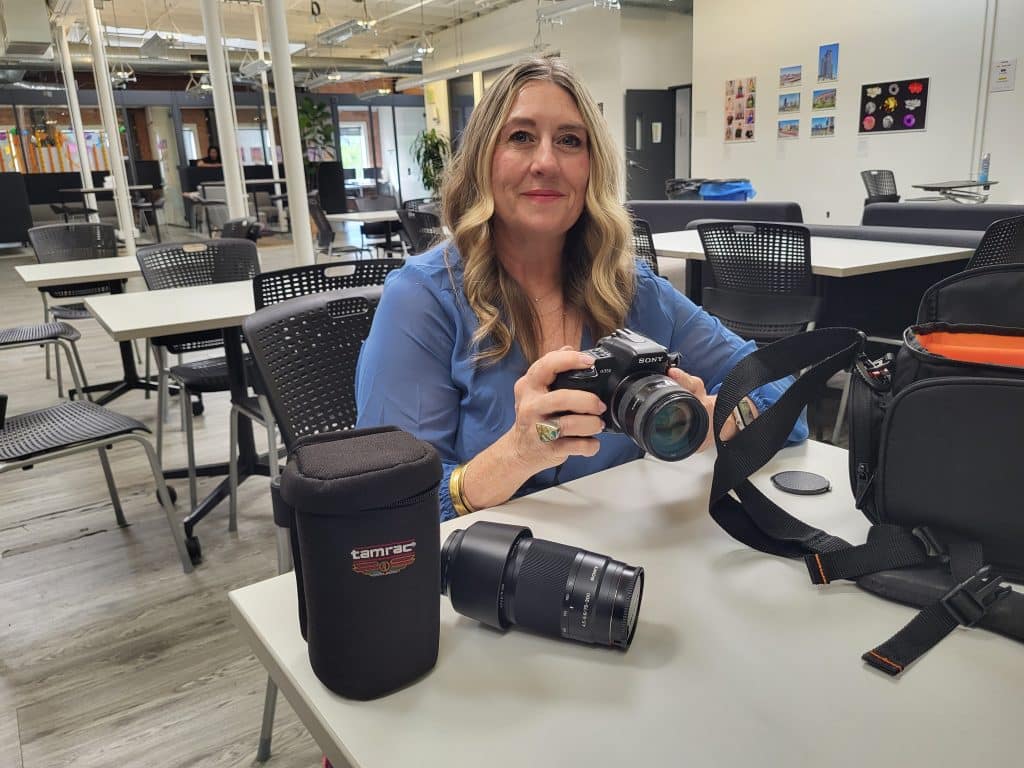
Outside The Lens Executive Director Sarah Beckman speaks glowingly of founder Elisa Thomson.
“She was a commercial photographer and had been teaching a class at the Museum of Photographic Arts,” Beckman says. “OTL is such a compelling story. The original idea was to give a kid a camera and they can change the world. That’s the idea. The foundational experience of feeling value. That your voice and your perspective has value and purpose in the world, regardless of where you’re coming from.”
It took eight years for OTL to be formalized into a nonprofit. It became a community outreach and connection program that supports and helps fill a gap in schools delivering core curriculum using media arts. OTL hosts classes and workshops in its downtown facility and also sends teachers and materials into local schools, 37 at last count.
What’s been consistent is the youths we’re serving,” Beckman says. “Systemically marginalized youth navigating really challenging circumstances. Now it’s beyond the refugee community and students whose families may be unhoused. There’s teen parenting. Students might be in a detention facility. Kids in the foster care system, or from Title I schools (which receive federal funding for low-income students).”
This is Beckman’s third year in the executive director seat. The graduate of University of Wisconsin-Madison previously worked at the San Diego Museum of Art, The New Children’s Museum, UC San Diego and Forever Balboa Park.
As a veteran nonprofit leader, she‘s tasked with overseeing growth. OTL’s most recent budget was $2.9 million. Throughout the year, the school has dozens of student programs starting and ending. The staff includes 16 fulltime instructors who last year mentored more than 3,000 students.
OTL has a stockpile of industry-grade technology. Students are never asked to pay for using it.
“Yes, we’ve moved on from disposable cameras to the Sonys and Canons you see here,” Beckman says. “Our students can actually use materials and equipment to know what it’s really like out in the real world. When you match creative confidence with the skills and technology, then you’re able to imagine the possibilities.”
Beckman loves to imagine the possibilities. And dream about the change-making that may be incubating here.
“We allow students to think about what change they can make,” Beckman says. “Who are you telling your story to? How are you telling it? What method are you using? Are you advocating for yourself or your community? Is it civic engagement? Do you want to take an entrepreneurial route? Are you looking to change your own trajectory for financial independence?”
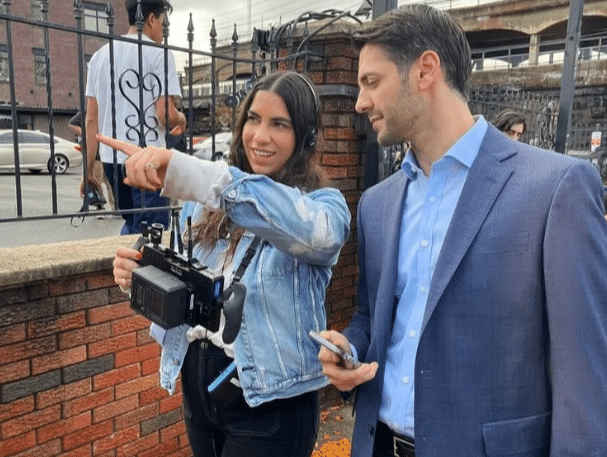
One of OTL’s success stories is a former student who’s now a full time video producer/director for Conde Nast media company in New York City. Skylar Economy, 32, primarily shoots for Architectural Digest, though sometimes she gets pulled onto projects for Vogue, Conde Nast Traveler or other brands.
A dream job? It is when she finds herself at video shoots at the homes of celebrities the likes of actress Emma Roberts, activist Gloria Steinem and DJ Diplo.
Economy went to school all over San Diego – Pacific Beach, UTC, La Jolla, High Tech High – and participated in OTL for three years. During her senior year, she went to Jordan in the Middle East during the Syrian War. She helped oversee an art project in which Jordanian youths combined poetry and self-portraits.
“That experience was beautiful and special and changed the course of my life in a lot of ways,” Economy says.
As a teenager, Economy had a secret. It was only a few years ago that she publicly admitted she has epilepsy. Her older brother was born with epilepsy, too, and began having seizures at an early age. She didn’t start showing signs of the neurological disorder until she was 15.
“I decided to keep my epilepsy between me and my parents,” Economy says. “I didn’t tell anyone then because I didn’t want to have a stigma. I saw the impact that disability and epilepsy had on my older brother and I didn’t want that to be a bar for me. Especially entering the film world where they’ll pick the production assistant that doesn’t have epilepsy over the production assistant that does.”
Economy’s type of epileptic seizures are less severe. She primarily controls them by medication. Holding a secret about a disability creates additional challenges for a teen girl. But OTL was a relief. And made an impact on her life.
“It was cool to see people at OTL who I grew up with, and connected with, be able to amplify their own voice through art, and be empowered by art,” Economy says. “It made me realize I can share my voice in different and more creative ways, and maybe that’s more powerful at the end of the day.”
Along with her Conde Nast job, Economy’s also working on independent films. One is an autobiographical work about her life with epilepsy. She’s been working on it since April 2022 and is still raising funding to finish it.
“It’s a hybrid film that’s part documentary, part scripted, that’s a lot of me going back home to San Diego,” she says. “Having conversations with my family that I’ve never had before. Seeing my neurologist. Figuring out if there’s any way I can get the epilepsy cured – essentially, no, there isn’t.”
Economy says the film, currently called Seizures, will recreate memories. Like the time she saved her brother’s life by informing her mom (before she was old enough to speak) that her brother was alone and having a seizure.
“This is like me being the director of these traumatic memories as opposed to living through them again, and finally coming to terms with what that means for my future,” Economy says.
If she can finish the film, it would be as if Outside the Lens had made it inside the lens and onto the big screen. Presenting the Hollywood version of OTL’s mission. A story about an artistic young girl with a secret disability who triumphantly makes a movie about her life. It could help heal inner wounds. As well as inspire others to see that if you give a kid a camera there’s a chance they can change the world. SDSun