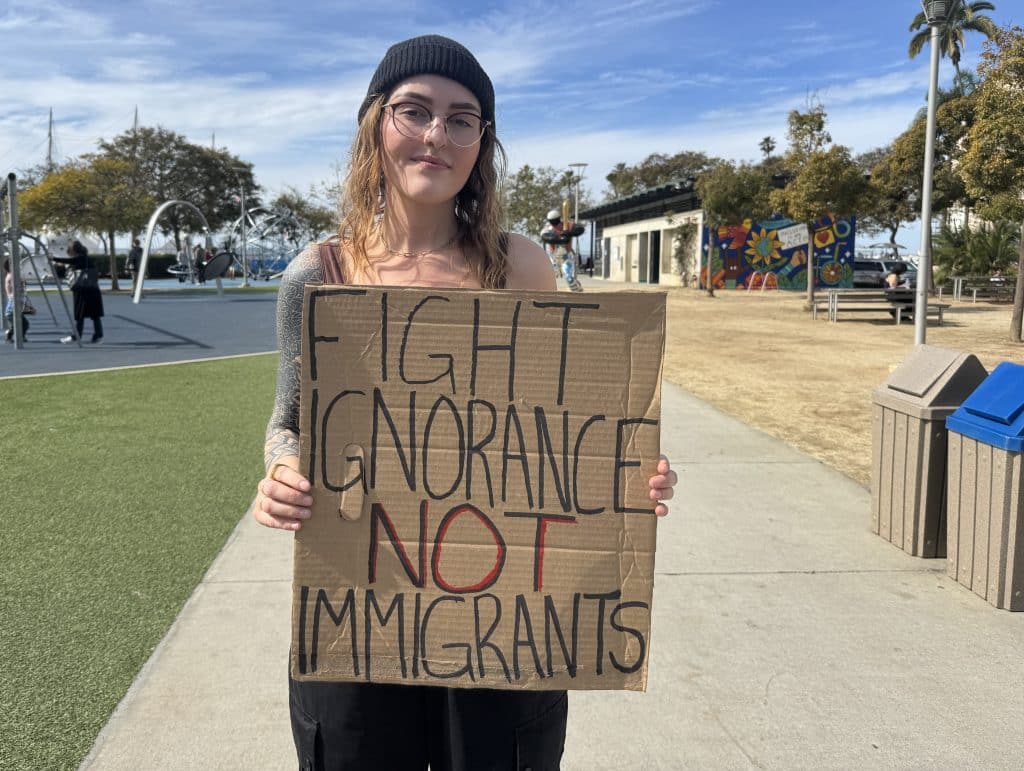
Protesters gathered by the hundreds at downtown’s Waterfront Park near the County Administration Building on Sunday, February 9, carrying flags, signs and a variety of concerns about President Donald Trump’s new policies.
These protests have been happening in all 50 states, and while San Diego is a border town, ICE raids weren’t the only issue that stirred people to take to the streets.
At issue for protesters: human rights, border issues, transgender rights, environmental justice and animal rights.
One protester was attending her first-ever rally. Another has already marched or demonstrated six times this year.
South Chula Vista resident Diego Zavala-Morineau was at the rally to disrupt routine and bring awareness to intertwined struggles affecting communities both in San Diego and abroad.
“What we saw here today downtown was a coalescence of multiple movements,” Zavala says. “People are in fear of having their families taken away [and losing] autonomy over their bodies. They fear a fascist government.”
History is being erased and curriculums changed, Zavala says. Teacher unions are being dissolved. Ethnic studies are being threatened.
“That’s why I signed up here today,” he says. “The way citizens are treated in regards to their rights, their human dignity, ability to [control] their bodies – that is a reflection of how this country is exerting its imperialism across multiple regions.”
This was Pacific Beach resident Heather H.’s first protest. She lived in New Jersey and New York for eight years and watched movements like Black Lives Matter from her stoop. Back then she was dissuaded from participating, for fear of violence. Today, she wasn’t worried.
“I’ve always watched from afar,” she says. “I want people to be able to stand up for what they believe in – I don’t think anybody should be getting hurt when trying to [exercise] free speech.”
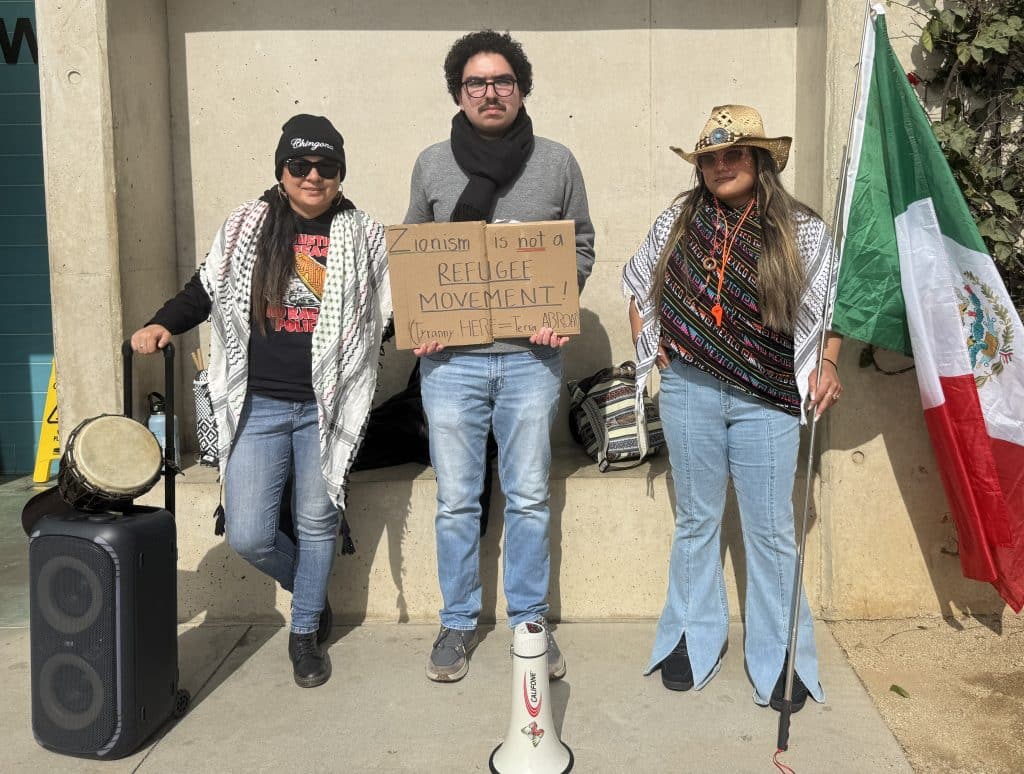
Barrio Logan resident Monique Sandoval-Salcido is a long-time Chicano activist. Sunday was her sixth protest in 2025, contributing to a 15-year history of activism with the movimiento (Chicano movement).
She says the rally at Waterfront Park was part of a larger, intertwined struggle with Latinos, Mexicans, Black people, Palestinians and others against injustice.
Sandoval-Salcido brought her drum set and a speaker system. She says it helps organize, empower and rile up marchers, as well as spread the message to passersby.
“I play political music in English and Spanish, and sometimes that riles up the crowd to chant louder,” Sandoval-Salcido says. “A lot of [politicians] are in and out of these buildings. This is where you come to get your passport. It’s a Sunday, but it’s more to bring awareness to everybody in their everyday routines.”

University of California, San Diego students Crystal Castellanos-Ante and Karina L. are both from Oxnard, CA, which has a large Hispanic demographic. Castellanos-Ante’s carries a sign that translates to “My mother works harder than your President.” Her mother is a teacher.
“My parents are both immigrants,” Castellanos says. “She’s always staying up late, till 6 p.m., teaching kids – especially the ones that have just immigrated from Mexico. She’s always trying to get them on [par with] their grade level.”
Classmate Karina L. chose to attend the protest because there was no political scene at her campus.
“I thought that there wouldn’t be protests [in San Diego], because at UCSD, I don’t know how much activism goes around there. There’s not much [Hispanic] representation at UCSD,” Karina L. says.
Mira Mesa resident Rebecca Gutierrez feels the fight is personal. Her grandparents and father came to America as undocumented Mexican immigrants. Today, they have papers.
“I’m lucky, because all of my family is documented, but if that weren’t the case, then [ICE raids] would definitely impact my family,” Guttierrez says. “I don’t think it’s right to deport people, especially when this area used to be Mexico. And now, [ICE is] trying to kick out people who are working and contributing to our community.”

Normal Heights resident Gabriela R., who is both Hispanic and queer, says the Trump administration’s actions threaten the rights of communities she cares about. She sees the impact in her own backyard.
“[Trump]’s done a lot to try and undo different social networks [regarding] immigrants, women’s bodies, trans rights, and specifically gay rights,” she says. “Being a border city, we are actively seeing people being taken away and put into immigration sites that are right in our neighborhood. Being so close to the border, we have a lot of opportunities to do really great work that’s on the front lines.”
Ocean Beach resident Serina Cuza is a student at City College and a member of Students for Justice in Palestine. She helps organize events because she feels it’s important to “bridge the gap between campuses and community.”
“There’s so many parts to activism,” Cuza says. “It’s not just marching. It’s sharing on socials, it’s sharing knowledge and power with people you meet on the street and in stores. It’s not ignoring anyone that is willing.” SDSun