“This story was originally published by inewsource and its San Diego Documenters program. Sign up for its newsletters.”
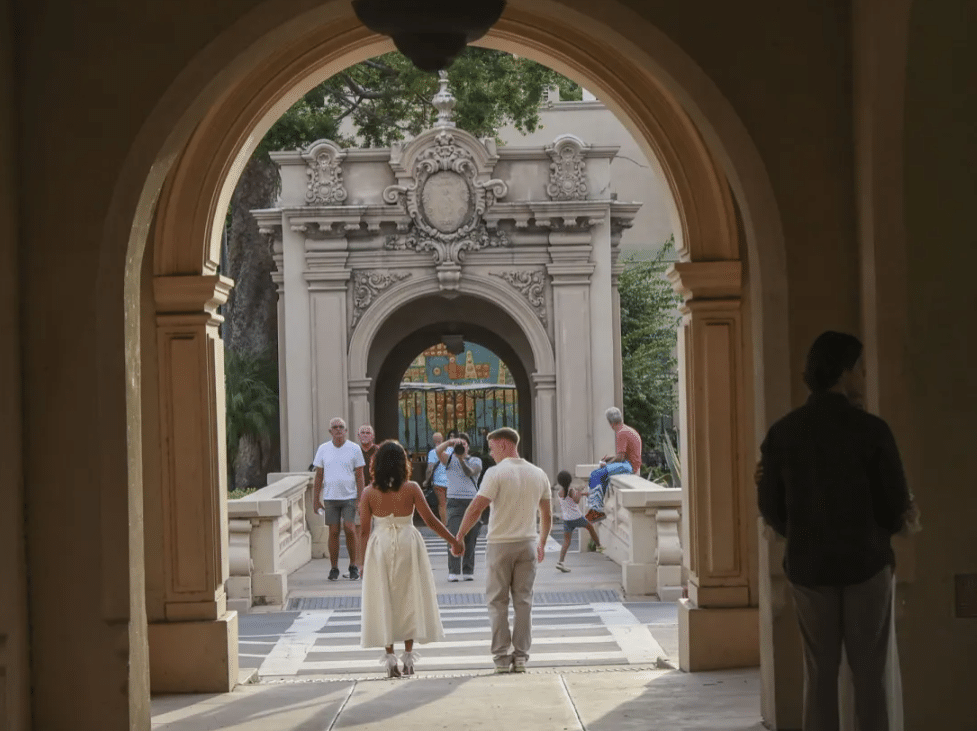
Maybe it was the place where you had your engagement photos taken, somewhere among the winding paths and colorful flowering shrubs.
Maybe you remember that time walking in the rose garden, the magnificent colors and the scent.
Just about everyone remembers the first time they went to the zoo.
Or a grade school field trip to one of the museums.
Perhaps your memories of Balboa Park are more intimate. The time when the grandparents set you on a horse at the carousel and watched, beaming, as you circled around.
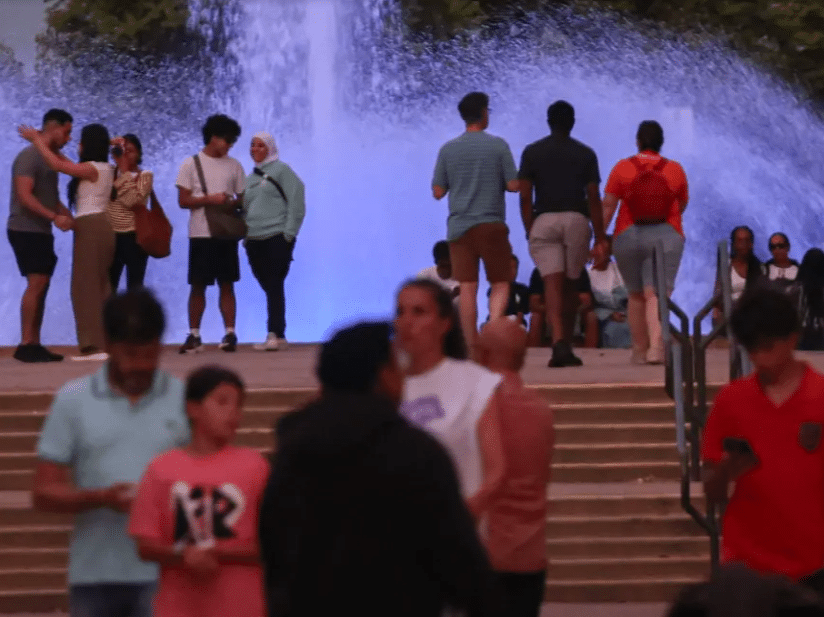
You took photos in front of the fountain, on one of those San Diego days clear and golden. Or, wept quietly at a play under the stars at the theater.
In a city of neighborhoods as varied and distinct as San Ysidro and La Jolla, Balboa Park is everyone’s neighborhood. If you live here long enough, chances are you’ll end up, someday, somewhere in the 1,200 acres of the park.
But take a closer look. The park’s iconic buildings housing some of the city’s more popular museums need work, from roofs to foundations. Sidewalks are uneven in places, portions of the many gardens look exhausted. Perhaps the less said about the public bathrooms, the better.
Since 2004, a raft of studies by private organizations and the city have sounded the warning that the park needs help. While there is no firm figure, city officials say the park needs close to $1 billion in deferred maintenance and capital improvements.
Two throughlines run through the reports: The park should have a dedicated revenue stream. And the governance of the park — with its dozens of museums, clubs and organizations — needs reform.
One of those many reports, published in 2022, noted that this was a “critical moment” for the park and its challenges. Four years later, the moment hasn’t gotten any less critical.
The city has embarked on an update to the park’s master plan that is supposed to be finished in 2028. It will address how to tackle key issues such as infrastructure needs, access, and preserving the park’s natural and historic elements.
Balboa Park is regularly called San Diego’s “crown jewel,” but for years now — decades, really — that crown has become tarnished, the jewel far less glittering than it could be.
‘We’re Not There Yet’
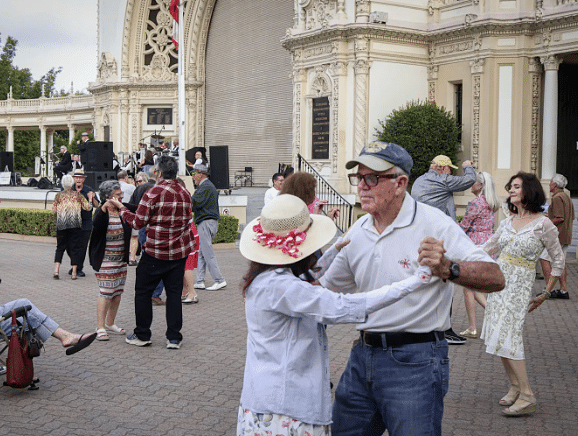
For many visitors, Balboa Park remains a captivating place. Interviews that members of inewsource’s Documenters program conducted found that locals recognize the park needs work, but are largely unaware of the extent of the task. Tourists, especially, are captivated by the park’s architecture and bucolic feel.
“I was impressed by the landscape,” said Mary Ammerman, a tourist from Colorado. “Even with how old the buildings are, they look super well-maintained.”
Appearances can be deceiving.
The front of some of the buildings in the Pan American Plaza look fine — stroll around the back and you’ll see signs of neglect and delayed maintenance including paint-chipped walls and discoloring. The same can be said of other structures, even though many have undertaken much-needed renovation work over the years.
No one knows exactly how much the park needs in deferred maintenance and infrastructure projects. A city-sponsored study in 2016 found $444 million of work had to be done by 2036.
A decade later, city officials acknowledge that number has probably doubled.
San Diego’s financial constraints make tackling that backlog challenging, if not unrealistic. The city spends between $25 million and $30 million from the general fund annually to run the park, mostly through the Parks and Recreation Department. The city pays about $4 million per year for the water costs for the park and its institutions.
But the park has no dedicated revenue source of its own unlike, say, Mission Bay Park with its numerous leases for commercial enterprises throwing off millions annually. A portion goes to the general fund, and a portion stays within Mission Bay Park for improvements.
The cultural and nonprofit institutions in Balboa Park don’t pay rent to the city. Under a policy adopted in 1980, the leaseholders are responsible for maintenance but not for major electrical, plumbing, structural and exterior work, which falls to the city.
That can cause problems for the institutions. In September 2024, an electrical short in the aging HVAC system for the Museum of Us caused enough smoke to require the San Diego Fire-Rescue Department to respond.
There was no fire, but the smoke damage was extensive, said former museum executive director Micah Parzen. The museum had to submit a claim to its insurer for about $500,000 and has been painstakingly cleaning smoke-damaged artifacts since.
Parzen, who recently left the museum after 16 years to run the Hearst Museum of Anthropology at UC Berkeley, said other institutions in the park have similar tales of woe.
Parzen said the city does the best it can and is responsive when there is an immediate problem that could imperil museum collections. But sometimes the city frustrated him.
“I felt like the city took a death-by-piecemeal approach,” he said.
“It would sort of see a problem here and address it, and see a problem here and address it, but not really think about the larger ecosystem and how yes, you might be solving an immediate problem here, but you’re creating longer term problems in other components of the ecosystem that end up haunting you down the road.”
It’s not that the city is not spending money in the park.
Nearly 2 miles of old water lines running through the park were dug up and replaced, Park Boulevard was resurfaced, and there have been improvements to the facades of the Municipal Gym. A $28 million renovation of the Botanical Building was done in partnership with the nonprofit Forever Balboa Park.
“We’re putting money into the park,” said Jon Richards, the city’s deputy director for the park. “Are we putting $1 billion, or $800 million? No.”
“But that’s a big number you’re trying to get to,” he said of the maintenance and infrastructure tally. “And we’re not there yet.”
There have been various suggestions over the years for providing the park with its own revenue stream. A 2022 report for the Burnham Center for Community Advancement recommended a trio of options — a parcel tax for three to five years that would tackle deferred maintenance, a bond issue by the city, or by a newly created Joint Powers Authority of the city and county governments.
The Burnham Center updated that report in 2024, taking into account the city’s worsening financial condition. “With the City facing ongoing financial constraints and unexpected events, expecting it to single-handedly rectify decades of underfunding is unrealistic,” the report noted.
Mayor Todd Gloria recognized this constraint and signaled a different approach to funding the park would be needed when he gave his “State of Balboa Park” address in 2023.
“My focus is on working with partners to accomplish more than the city can do on its own,” he said then.
That public-private work was on display with the restoration of the park’s Botanical Building. The city did the structural work then handed off a second phase of landscaping and a pergola to Forever Balboa Park, which is taking an increasingly active role in park governance under an agreement with the city.
Creating a specific revenue stream for the park can be fraught, however. Look no further than last year when Gloria and the City Council’s move to institute paid parking blew up.
The ill-fated program was supposed to supplant the roughly $15 million from the general fund earmarked for the park. Any revenue over that would go toward tackling the backlog.
The backlash was intense, from residents as well as the institutions in the park who said they saw their traffic plummet when the metering went into effect. Residents were furious and saw the move as a gambit by the profligate city to fill its yawning $146 million budget deficit.
After months of pushback, the council abolished the program. Paid parking ends Jan. 1.
Lost amid the outcry over the overall city budget was that the paid parking represented an attempt at creating a revenue stream solely for the park — and not relying on the general fund, or at least being less dependent on it.
“If we had been talking about paid parking as one of many possible revenue sources for the betterment of the park, it might have been a different conversation,” said Katy McDonald, the president and CEO of Forever Balboa Park.
In an interview, Gloria said the park generating its own revenue is the best long-term solution.
“My priority has been to try to get it off the general fund,” he said. “That means that it supports itself through revenue it makes on its own or through philanthropic commitments. And I think that’s absolutely a reasonable and doable goal.”
For McDonald, the parking controversy illuminated a larger issue about operating the park.
“The bigger question, and the challenge before all of us, is how important is the park to us? And what are our options as a community for funding the resources that are needed to make this the park that it could be?”
A Conservancy?
Balboa Park can be seen as three distinct parks.
The Central Mesa is home to the park’s cultural district of museums.
East Mesa is home to an array of recreational attractions — archery range, swimming pool, golf course, velodrome and more.
The smaller West Mesa near Park Boulevard has meandering paths, the historic Marson House, lawn bowling and a playground.
One of the challenges for governing the park is not only that diversity of purpose, but also the diversity of interests from its many constituencies.
In addition to Forever Balboa Park there is the Balboa Park Cultural Partnership, made up of the institutions clustered on the Central Mesa, and the Committee of 100, composed of citizens focusing on the park’s buildings, gardens and open spaces.
The park also has a 12-person city advisory board.
“A systemic and structural governance management needs to happen in order to serve a modern Balboa Park that is up to international destination standards,” said Tad Seth Parzen, Burnham’s president and CEO.
The various governance groups in the park focus on a specific area: arts and culture, open space, historical preservation and so on. The Burnham Center’s reports have suggested adopting a different model — a conservancy, which would be a nonprofit that would take a strong leadership role in the park.
The conservancy would operate under the direction of the city but take on the task of raising money and even managing projects.
The idea was first floated 15 years ago during the Jerry Sanders administration. Also supporting it at the time: then-councilman Todd Gloria.
A city-sponsored 2008 report — titled “The Future of Balboa Park” — also recommended the model.
That ambitious concept has yet to take shape. Gloria, who favors such a model, said the city’s partnership with Forever Balboa Park is working but it is not as robust as what the 2008 report called for.
“Have we gotten to where I think Forever Balboa Park wishes to be? Probably not,” he said. “But I’ve seen iterative steps toward more responsibility, more authority in the park. And I’m very supportive of continuing down that path as they show more proficiency in fundraising and good stewardship of park resources.”
New York’s Central Park has a conservancy, and it took several years before it was a force in the famous park, Gloria pointed out.
Getting all the entities in Balboa Park on the same page could be a tall order, and might take years. But McDonald said it is worth a try.
“It’s a model, absolutely, that can be successful and is worth investing in,” she said.
Still, the work is substantial. A city-funded study published in 2025 set out to prioritize the capital infrastructure work that has to be done in the park. The study made a list of 61 separate projects, from redoing parking lots to new floors and HVAC systems to rehabilitation of entire buildings.
More than a century has passed for the chemistry of architecture, nature, culture and open space to make what is Balboa Park today. It’s still filled with people daily, still a locally loved and internationally recognized landmark that attracts and makes memories for its millions of annual visitors.
The challenge now is to keep it that way. SDSun
Greg Moran joined inewsource in January 2024 and covers elections, extremism, legal affairs and the housing crisis. He worked at The San Diego Union-Tribune from 1991 until July 2023, where he specialized in courts and legal affairs reporting as a beat reporter, Watchdog team reporter and Enterprise news writer.