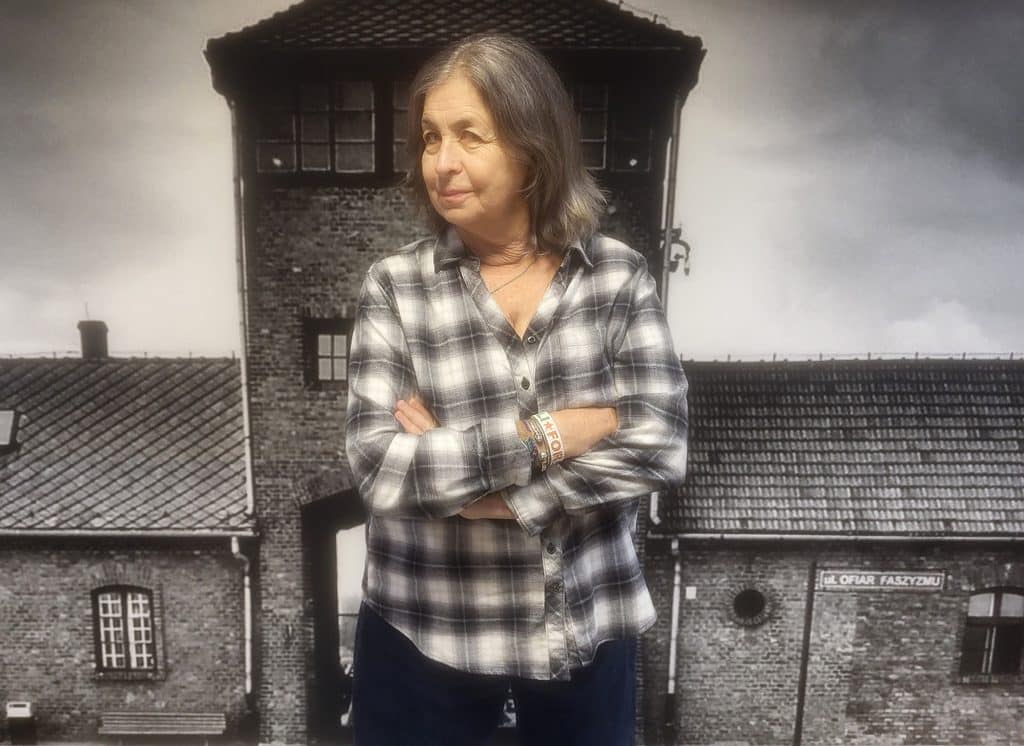
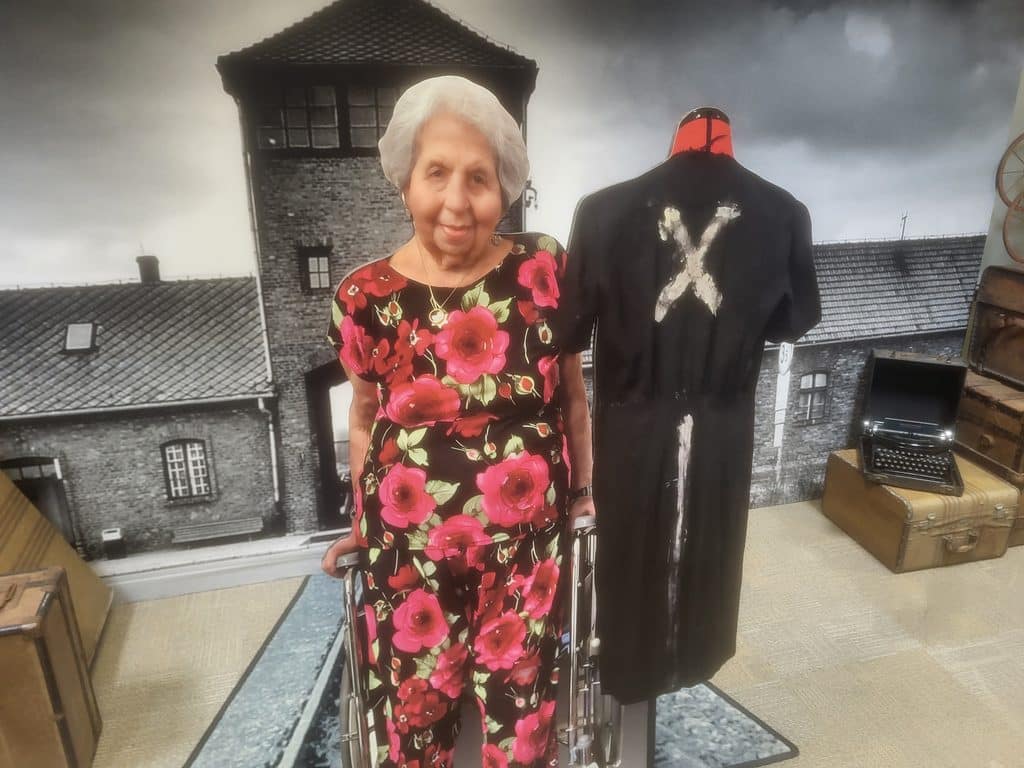
Ruth Sax was a Holocaust survivor. Along with her mother, Erna, she was imprisoned in the infamous Auschwitz concentration camp. Both were liberated near the end of World War II. Before Ruth passed away in San Diego in 2018, she and her daughter were going through some belongings. One of their possessions was the dress Erna wore during her time inside the Nazi Germany-run camp.
The black, wool gaberdine dress was marked with a white “X” on the back. Near the end of the war, when the more historically recognizable striped uniforms were in low supply, Jewish prisoners wore civilian clothing marked with paint.
Ruth’s daughter is Sandy Scheller. “My mom said, ‘When I die, either bury me in my mother’s dress or make a museum,’” Sheller said.
Scheller has been toiling for seven years to achieve the latter. An exhibit called RUTH: Remember Us The Holocaust will formally open at 6 p.m. on September 29 in the downtown San Diego Central Library.
The RUTH exhibit includes rare Holocaust and World War II artifacts, including documents, photographs and personal belongings.
“History must be preserved and told, never forgotten,” said Scheller, who is both founder and curator of the exhibit. “Each artifact tells a story and represents a piece of history that may otherwise be lost forever.”
RUTH is slated to be an exhibit at the downtown library for at least two years. Previously, it was housed in the La Jolla/Riford Library. Before that, it lived in Rancho San Diego and Chula Vista.
The ultimate goal is a permanent museum in San Diego. Scheller and a team of boosters are actively looking at spots in downtown and Liberty Station.
“We’re grateful to San Diego County and the Downtown Library for giving RUTH a home for the next two years, but we already know this cannot be our final destination,” RUTH Executive Director Dr. Moises Salinas Fleitman said in a statement. “Memory needs an address. San Diego needs a permanent place where Holocaust history can be presented.”
While curating the RUTH exhibit all over San Diego County, Scheller says she’s seen firsthand the need to remind and educate people about the Holocaust, the name given to state-sponsored persecution and murder from 1933 to 1945 of six million European Jews by the Nazi regime.
Scheller says she’s confronted antisemitism over the past seven years. And has also seen young and old people leave the exhibit with a sense of understanding, some possessed with the spirit of “never again for anyone, anywhere.”
The exhibit will occupy roughly 1,000 square feet in a second-floor room in the downtown library.
The San Diego Sun got a sneak peek. The first aspects of the exhibit that catch your eye are the life-sized, cardboard cutouts of San Diego Holocaust survivors. All were photographed smiling and are hauntingly welcoming. Scheller puts her arm around one cutout and gives it a kiss, then hugs another cutout. “Don’t you love his hat? she asked.
The museum includes one of the early World War II-era striped prisoner outfits. Placed under the uniform are an unknown survivor’s frayed gray pair of prison boots made of wood and canvas and stapled together.
There is a small installation made of prisoners’ brown and grey suitcases, and pieces of art from this dark time that depict enslavement. Several figurines show men in striped uniforms with skeleton-like heads.
THE OPPOSITE OF A FUN FACT: Despite being held in Auschwitz and other camps together, Ruth and Erna never acknowledged they were related. Why? Scheller says German scientists who discovered family members in camp were prone to do race-related experiments on them.
On display are the first two of 1,500 overseas letters Sheller’s mother and father, Kurt Sax, sent to each other after Ruth got out of the camps. You can see Kurt writes in perfect English, while Ruth starts her letter in English then halfway through reverts to German.
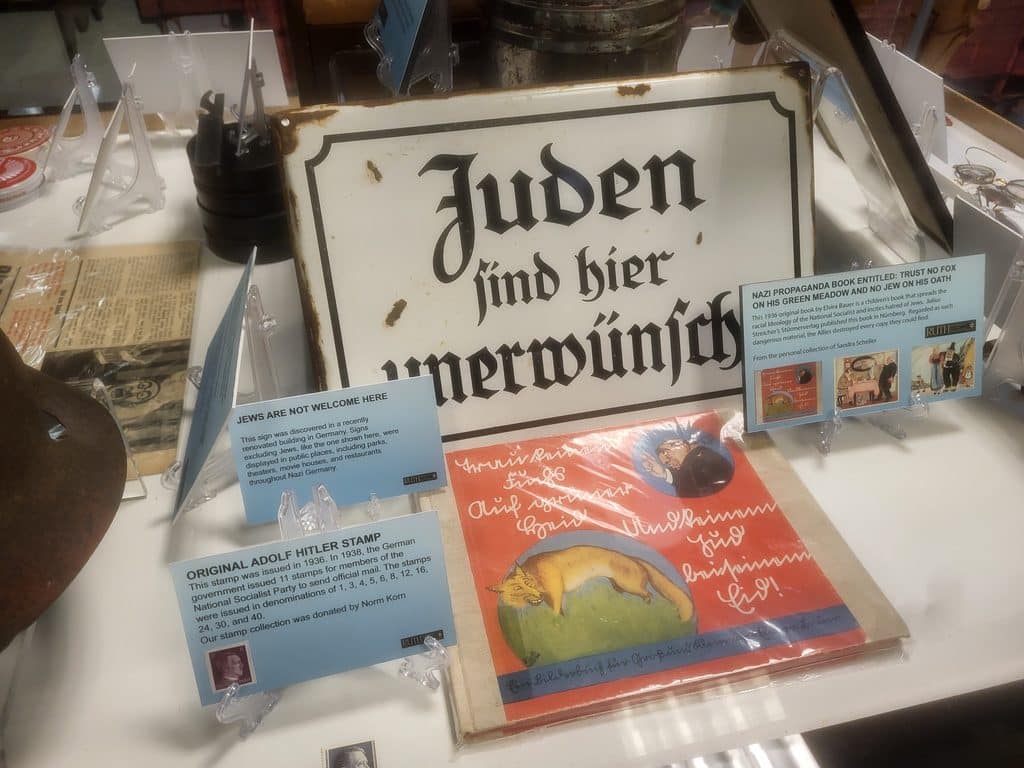
It’s difficult to recount the depth of emotion and describe all the historical detail on display at the RUTH exhibit. I was blown away by the heavily damaged remains of a steel German helmet. I somberly asked for a translation of a sign that read: “Juden sind hier unerwünscht.” (“Jews are not wanted or allowed here.”)
Scheller said her goal is to memorialize or somehow honor every Holocaust survivor from San Diego.
Over the past few years, Scheller said exhibit visitors have approached her with myriad questions.
“Mostly people ask, ‘Why? Why do we have hate? Why do we have this?’” Scheller said. “And I’m like, ‘Because we didn’t learn from our history.’ And if you’re not going to listen to what’s in a school book…Maybe you can hear it from the voices of the Holocaust survivors. And as you look around the exhibit, it’s very easy.” SDSun