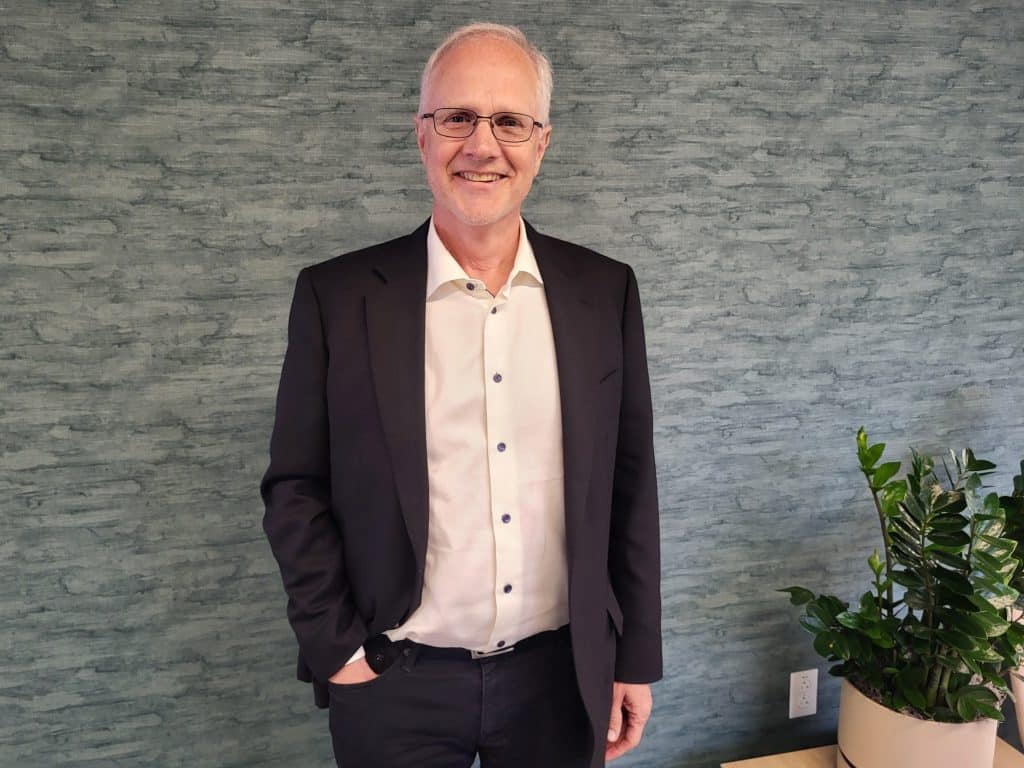
Grant Oliphant boldly claims that downtown San Diego has the potential to become a “cathedral.” Not a literal place of worship. Rather, an unprecedented place for people to come and “experience awe,” he says.
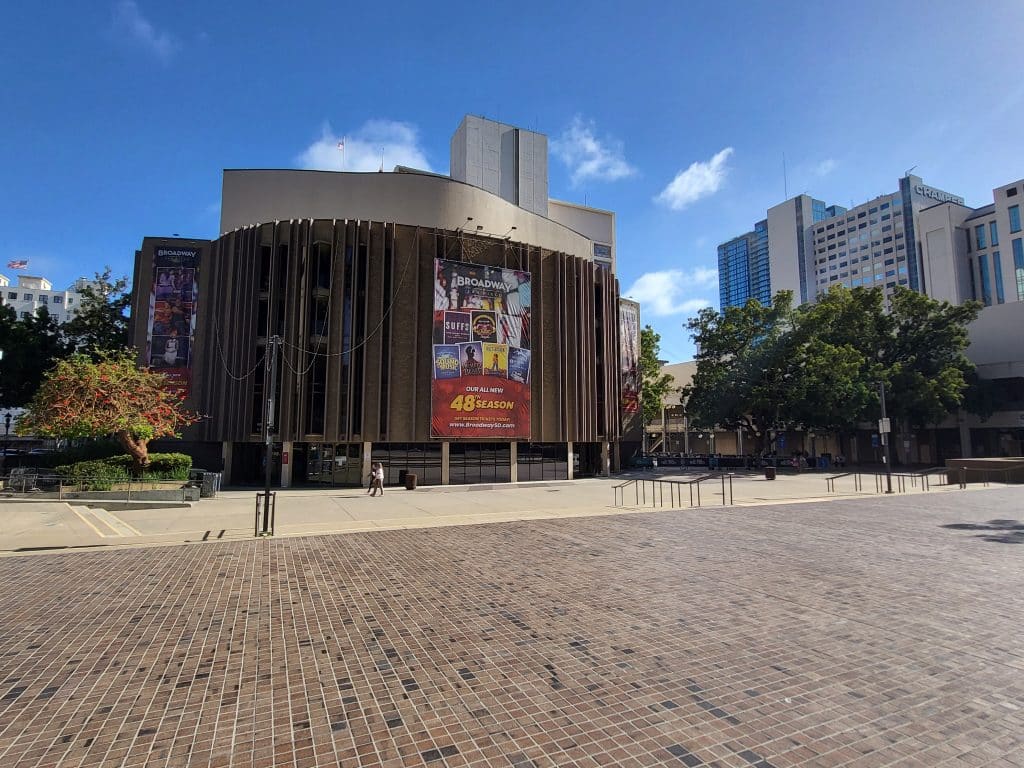
The CEO of the Conrad Prebys Foundation has a vision. On the job since 2022, Oliphant oversees a billion-dollar endowment. He conceptualizes a future urban San Diego — starting with the area around City Hall and the Civic Theatre — as somewhere people can go “to experience the rituals of daily life while also being in a place to think about higher aspirations.”
That’s a far cry from the current urban reality — diminished in part by homelessness, potholed streets and empty storefronts — but it’s music to the ears of downtown boosters.
“It is wonderful to find a funding partner like Prebys Foundation that shares our vision for what is possible in our urban neighborhoods,” Downtown San Diego Partnership (DSDP) President & CEO Betsy Brennan says.
Oliphant, 64, came to San Diego after working in Pennsylvania philanthropy for nearly three decades. He oversaw billion-dollar coffers at the private Heinz Endowments and the public/community-based Pittsburgh Foundation.
In a recent interview with The San Diego Sun, Oliphant was both issue-oriented and refreshingly convivial. He appears to be contemplative and reflective; simultaneously empathetic and likeable; and an upbeat, C-level problem solver.
Naysayers might question Oliphant’s stained-glass vision for downtown San Diego. Let’s be clear. When he was leaving his last job, a reporter asked if he had unfinished business at Heinz. Oliphant replied: “You take comfort in the analogy that philanthropic work is like building cathedrals. I don’t regret any of the cathedral stones we put in place.”
Oliphant stands by that quote and says San Diego is now his focus. He knows people might laugh at the cathedral analogy, but he’s serious about wanting to help raise the perception and reality of downtown San Diego.
He recalls the words of French writer-poet-journalist Antoine de Saint-Exupéry: “A pile of stones stops being a pile of stones the moment a person looks at it and starts imagining a cathedral.”
People can get caught up in the daily activities of life and just see a pile of stones, not what they could be, Oliphant says.
“Philanthropy has this gift of a longer timeframe and resources that are flexible,” he says. “We can therefore think about what the potential of that pile of stones is. The best foundations do this for different issues, and even on the issue of transforming a downtown.”
The Kresge Foundation set its sights on Detroit and Heinz focused on Pittsburgh, Oliphant says. Add Memphis (the Hyde Family Foundation) and Philadelphia (the William Penn Foundation) to the list of urban areas transformed largely from a philanthropic push.
“Multiple other foundations around the country have done this in their communities,” he says. “They’ve looked at unique sets of resources that they can help turn into something over time.”
Oliphant recalls Teresa Heinz pushing the idea to reclaim the waterfront in Pittsburgh. “She went to the window of our office on the 30th floor of our downtown tower,” he says. “She looked out and said some version of, ‘What is that monstrosity across the lane that has just been built? What a waste, why would we dumb down our city that way?’”
From that thought came inspiration for a contiguous, 13-mile waterfront loop in downtown Pittsburgh and more public-friendly parks. For 25 years, the concept was shepherded by a task force of stakeholders, Oliphant says.
“What I love is it comes from somebody who’s willing to look out the window and say, ‘We can do better than that,’” he says. “In Pittsburgh, people grew up believing that they should stay away from the water; that’s what kids were taught. Teresa didn’t care if people poked fun at a new concept. She saw the potential.”
The goal, Oliphant says, is to keep elevating what’s possible and make it harder to make dumbed-down choices in the future.
Successful property developer and latter-life philanthropist Conrad Prebys died in 2016. He gifted one million dollars to the Boys & Girls Clubs of East County. His $20 million endowment to San Diego State University annually supports 150 students. Before his death, he donated $100 million to the Sanford-Burnham Medical Research Institute.
After Prebys passed away, his apartment portfolio was sold in 2021 to the Blackstone Group for one billion dollars. The sale worried affordable housing advocates, who believed Blackstone would raise rents. There’ve been no recent reports of that. Meanwhile, the Prebys Foundation is flush with just over a billion bucks. It granted more than $55 million via 214 gifts in 2024, and gave out a similar amount the year before.
When Oliphant was hired in 2022, he expanded the foundation’s staff and board. The team is bigger, and still devoted to funding arts, medical research, programs that support youth issues, and many more efforts all over San Diego County.
At the Mexico border, the foundation invested a million dollars into research and advocacy to end pollution in the Tijuana River Valley. “I was flabbergasted that the border communities have to put up with that public health issue,” Oliphant says. “Yes, we wanted to take on harder issues like that with our philanthropy.”
He says the organization is careful about wandering into partisan political territory but does judiciously support the concept of diversity.
“Diversity has become a context-dependent word,” he says. “We talk about that, and equity and we talk about inclusion – but we don’t use the shorthand DEI as a term. Why? It’s become something that means different things to different political camps.”
Oliphant believes most Americans are open to the idea that everyone should have access to opportunity. “That’s regardless of your skin color, your ethnicity, your religious beliefs, your sexual orientation, what have you,” he says. “There’s a feeling in our country that there’s a DEI agenda. In our philanthropy, we’re just trying to focus on delivering on the American promise.”
Oliphant has definitely set his sights on delivering a better downtown San Diego. Moving the Prebys Foundation offices from Mission Valley to downtown’s Little Italy was intentional, he says.
“We’re active all over San Diego County and we want to be a foundation for everybody,” he says. “The one place you can reasonably be that, and a place where everybody can come and meet you, is downtown.”
In 2022, San Diego Mayor Todd Gloria assembled a 22-person Civic Center Revitalization Citizens Committee. The group produced a comprehensive final report. Afterward, there was scant interest in redeveloping the area. Then, the city’s quarter-billion dollar budget deficit took center stage. It appeared that like so many other commissioned San Diego studies, the Citizens Committee report was going to gather dust on a shelf.
The mayor’s communications team did not respond to a request for comment for this story.
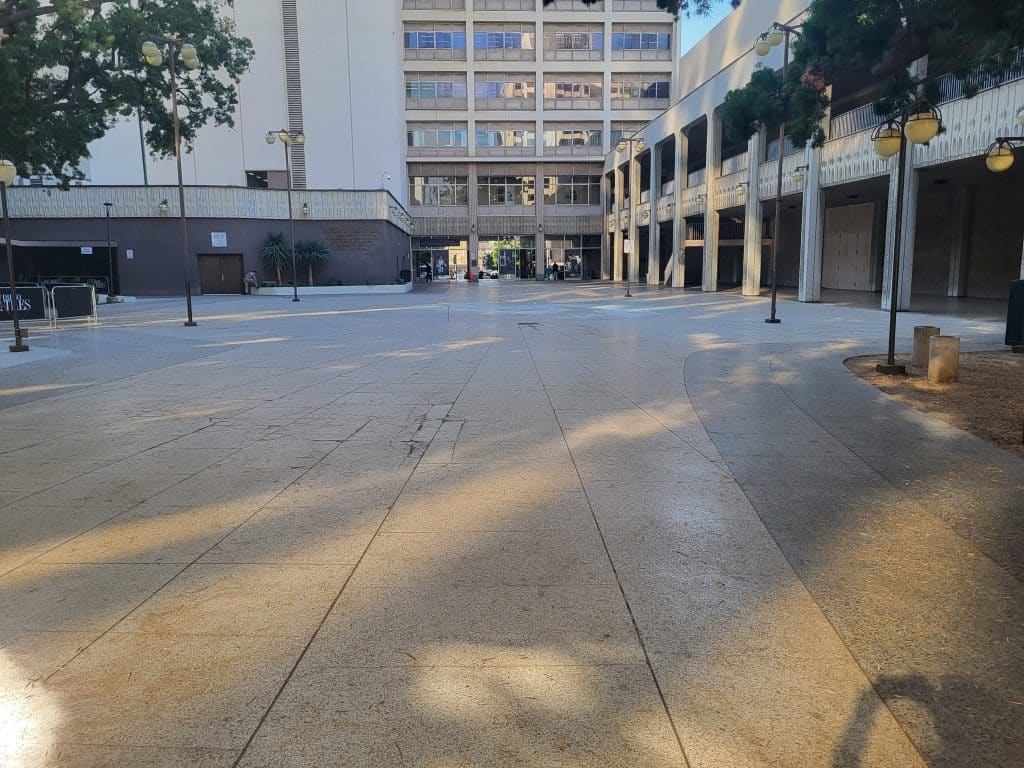
A city budget deficit didn’t stop the Prebys Foundation from moving ahead with its own $300,000 study through the DSDP. That study was done by U3 Advisors, a consulting firm that specializes in community impact and urban development. U3’s land-use study focuses on the six blocks that surround the Civic Center Plaza (which includes City Hall and the Civic Theatre).
“For too long, San Diego’s Civic Center has not lived up to its potential as a dynamic public space,” DSDP’s Brennan says. “With the release of this vision, we take what we have learned through months of stakeholder outreach, the previous work of the City of San Diego, and the historical interest in what is possible for this space as momentum to turn the page.”
The building blocks for San Diego’s future are in the Civic Center area, Oliphant believes.
“We want that space to be evocative of the aspirations of the community, and it kind of isn’t right now,” he says. “Right now, it expresses a kind of failed vision from decades ago that represented the best thinking about urban design at the time. We’ve learned a lot about what doesn’t work in urban design since then.”
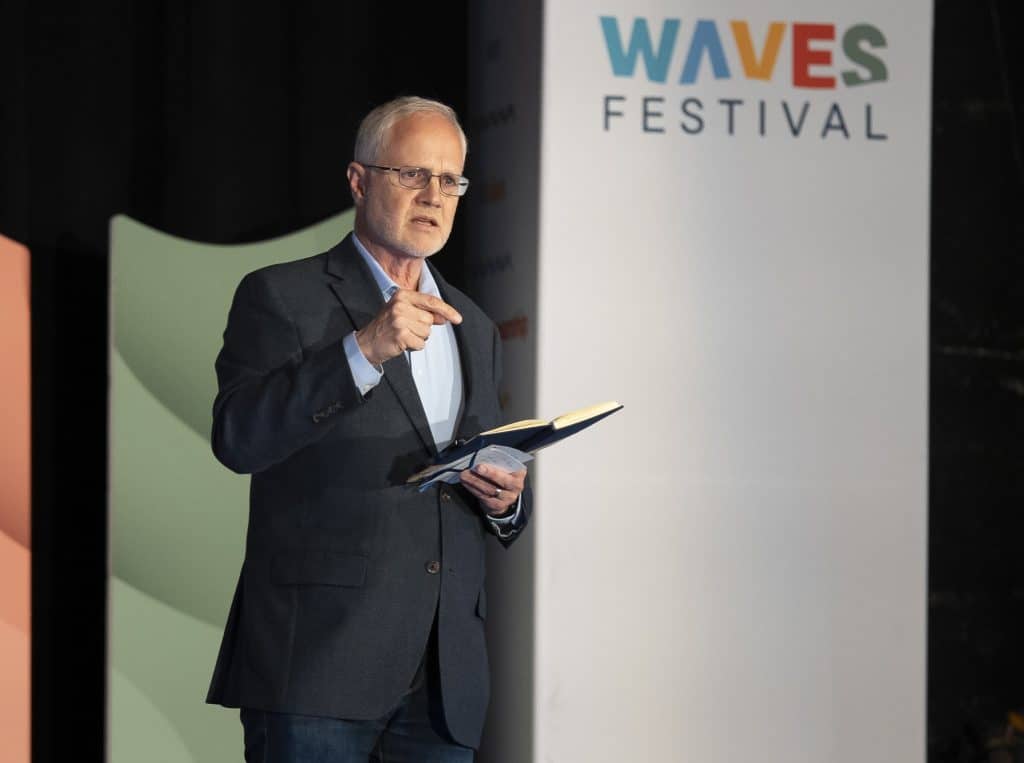
The U3 study was revealed at the foundation’s inaugural Waves Festival in early May. (The Prebys Foundation is looking at making the Waves Festival an annual event.)
“It’s not rocket science,” Oliphant says. “It’s a good vision for space that opens up the street grid, adds nature, moves some things around so they make more sense, makes more room for residential living, and then over time changes the buildings that are really in trouble like City Hall, the Civic Theatre and the Parkade.”
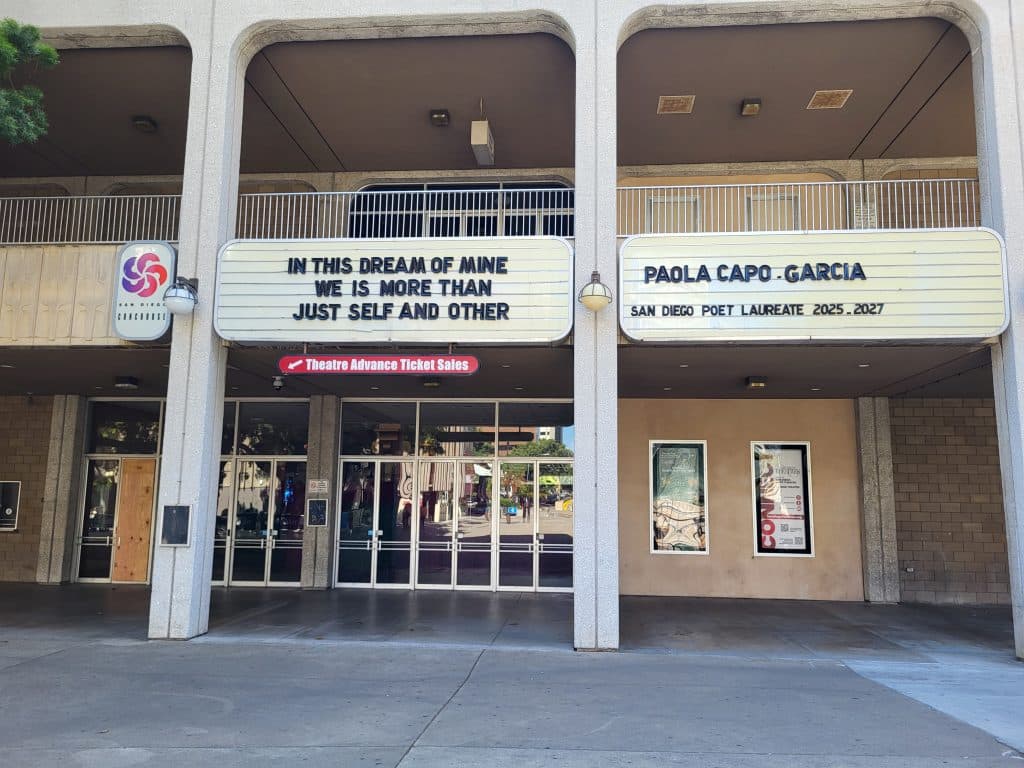
U3 Advisors CEO Omar Blaik says the San Diego study’s road map includes tearing down Golden Hall and building a theater (while the Civic Theatre continues to operate). When the new theater is ready – and it may wind up being part of a mixed-use arts and educational center – the old theater will be torn down. Walls that cut off the Civic Center Plaza from B and C streets will be razed, Blaik adds, opening into a community space that someday just might be the perfect place for a city Christmas Tree.
“The plan is to bring vibrancy and attract more people to the area,” Blaik says. “In many cases, philanthropy steps in when cities are struggling and don’t have the money and the vision to take on a transformative project,” Blaik says.
Oliphant agrees that San Diego’s budget deficit need not hinder progress.
“The first step to changing a space is in changing how people think about that space,” he says. “Then, you activate the space so people begin to see it being used differently.”
But funding?
“Everybody focuses on money, but time is the more important ingredient,” Oliphant says. “Yes, we’re in the middle of a temporary budget crisis, but the city was never going to pay for this, anyway.”
The city is in a position to attract state and federal money, he says. These aren’t the best of times, he adds, but if you have a vision and if you have players who are willing to stay with it, given time you can pursue it.
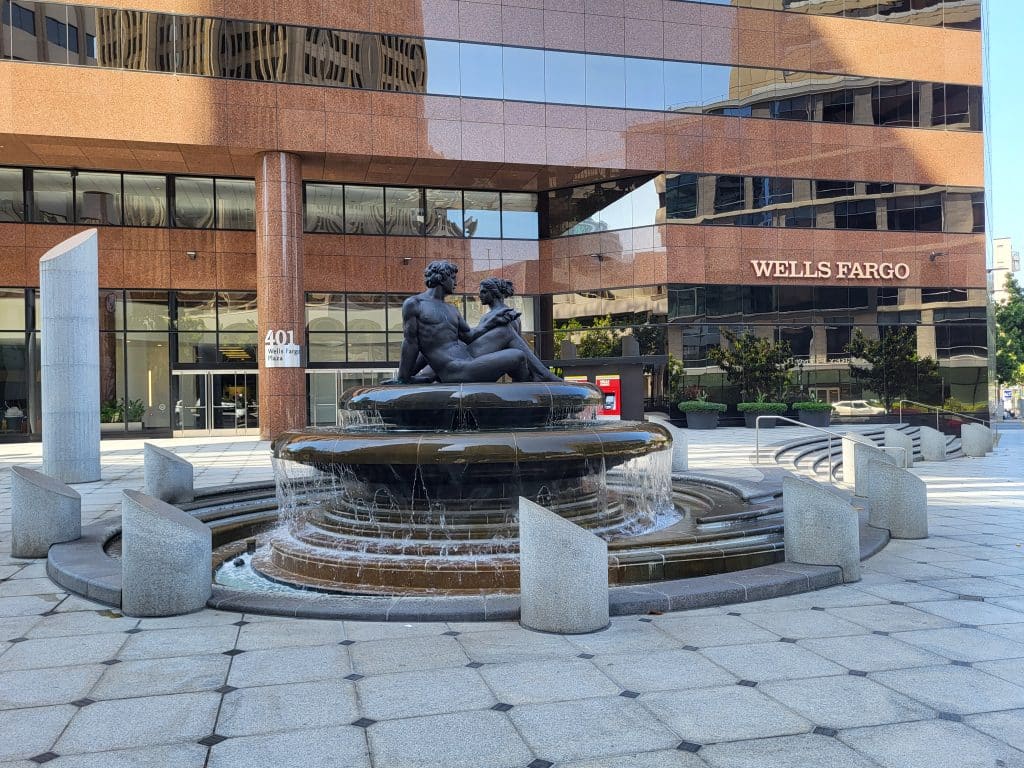
Another aspect of keeping the plan in motion was the Prebys Foundation’s $40 million purchase of the 24-story Wells Fargo Plaza, also referred to as 401 B Street. It’s a block away from the Civic Theatre.
“We made a decision that we were going to use some of our assets for impact because we care about using our money for San Diego,” Oliphant says. “The idea is, how do you use the billion dollars you have to work for your mission as opposed to just the $50 million you give away every year?”
It’s an impact investment, he says, adding that his accountant deems it a very good investment, too.
For now, the plan is to grow the occupancy of 401 B Street (it’s already home to the DSDP). There had been speculation of moving City Hall there. Oliphant notes that’s not likely at the moment, but points to an unfinished second floor in 401 B that could function as an incubator space. “We’re looking at all possibilities,” he says.
Possibilities he intends to metamorphosize into a cathedral. SDSun
(YOU MIGHT ALSO LIKE TO READ: “USD Students Create ‘Repair Manual’ For Aging Civic Center.”)