Before 1987, San Diego was the only large metropolitan area in the Western United States without a thriving Historic Asian District.
Today, two exist in the city: the Convoy District, an up-and-coming dining destination that recently got its own neighborhood sign; and Downtown San Diego’s Historic Asian Pacific District, which rarely gets attention or sees significant foot traffic.
“I’m two blocks from Gaslamp,” San Diego Chinese Historical Museum Executive Director Jacinta Wong says. “Two blocks from the Convention Center; two blocks from the Marina District. Nobody ever walks those two blocks to find us, you know – unless they know we’re here.”
Wong, who took over the job in March 2023, plans to promote the area, but says that navigating city bureaucracy has made her efforts difficult. She can’t figure out who to contact for access to historical information.
This was a stark contrast to how easy it had been to access city records in Chicago, when she was Deputy Director for the Office of the City Clerk and Program Manager for the Department of Buildings, Wong says.
When she got to San Diego, Wong looked into historic Chinese-style lights strung sporadically along Third Avenue. Some lights were on one side of the street but not the other. In some places, thematic lights were separated by non-thematic lights.
“I couldn’t find any historical documents to explain this rationale,” she says.
Although Wong reached out to San Diego’s Office of the City Clerk, their response didn’t fully address her questions.
“That information is not here in San Diego, and I don’t know if I’m not asking the right people or if [the city] doesn’t have it,” Wong says.
The San Diego Sun reached out to the Department of Historic Preservation Planning, the City Planning Department, the Office of the City Clerk and the City of San Diego Communications Office seeking comment on accessing city documents about the Historic Asian Pacific District.
The City of San Diego Communications Office directed The Sun to the California Historical Resources Inventory Database, but the documents provided did not contain architectural rationale for the district.
The City of San Diego Communications Office was unable to provide a comment about difficulties in accessing city records.
Finding city documents has been just one of Wong’s barriers.
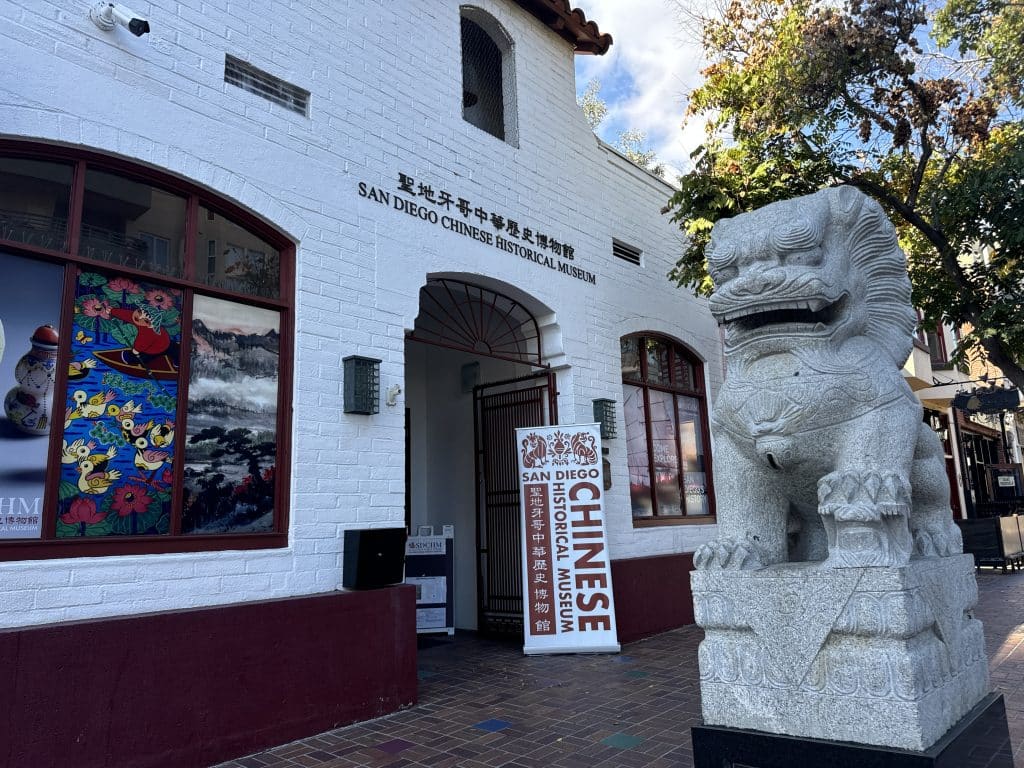
The downtown museum, located near Market Street on Third Avenue, is in the heart of the city but overshadowed by other attractions. Except for the Chinese Guarding Lions statues outside the museum, nothing is particularly distinctive about the district’s appearance.
The City of San Diego recognized the district’s historical and cultural relevance in 1987. City redevelopment plans intent on enhancing the district’s visual identity said new construction should “Preserve the uniqueness and richness of the existing Asian historic structures by enhancing rather than weakening their character.”
However, some historic Chinese buildings that surrounded the museum – 1800-era homes that doubled as storefronts – had been torn down.
“Nothing was worth salvaging because it didn’t look ‘specifically’ Asian,” Wong says. “[The city architect] didn’t take into account the fact that during the Chinese Exclusion Act, Chinese [people] weren’t allowed to own property.”
On average, Wong clocks in anywhere from 40 to 50 hours a week. She spends her time organizing events, networking with community partners and doing outreach, like teaching at educational events at public libraries.
“Considering that our museum is only open three days a week, it’s a lot of hours outside of the museum,” Wong says.
Wong’s museum team includes four part-time staff and 30 volunteers and docents, who keep operations functioning and tours running. Volunteer ages range from early 20s up to 84.
Docent and board member Jack Meng is a regular volunteer. “I’m retired, so I spend every Friday here,” Meng says. “Somebody has to do this.”
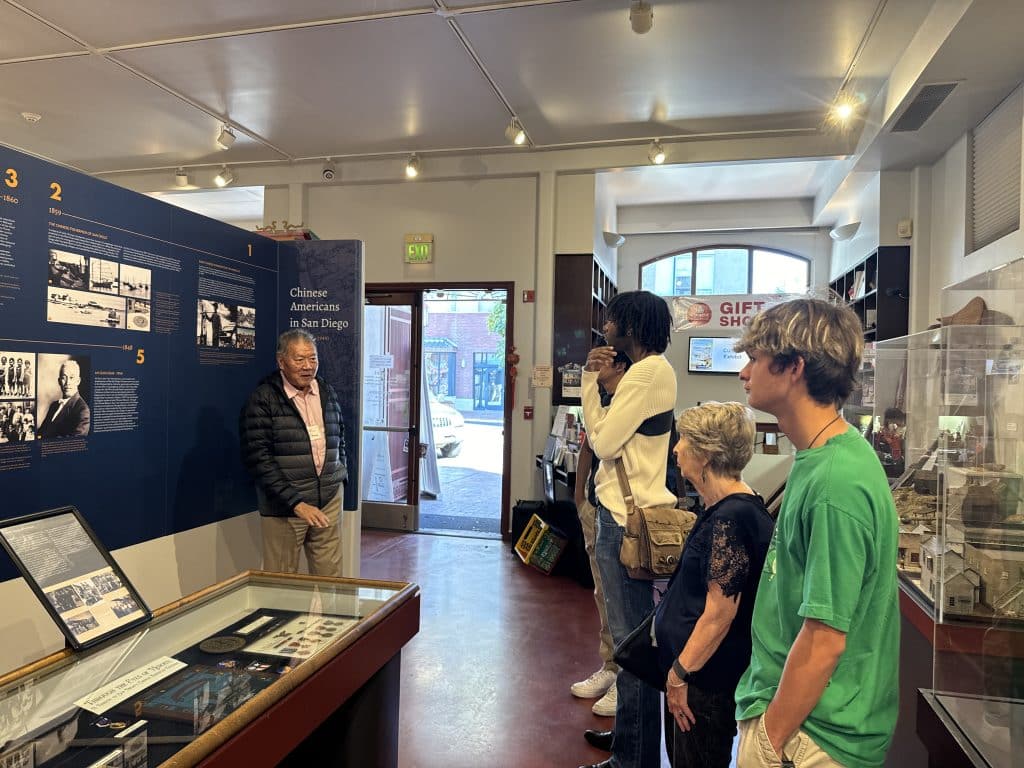
Half of the museum features San Diego’s Chinese-American history. The other half displays Chinese history: Buddhism and Confucianism; a jade burial suit, a limestone Buddha head and a warlord’s bed frame.
Board Secretary for the Chinese Consolidated Benevolent Association Kathleen Dang says historically, the development of San Diego County led to older residents and families in the historic district migrating to more suburban areas, like Claremont and Mira Mesa.
“The only keepers of history – including photos and stories of a once-vibrant, multi-generational neighborhood – are mostly being kept by the Chinese Historical Museum,” Dang says.
Wong has partnered with the business-focused nonprofit Downtown San Diego Partnership to create a mural on Third Avenue and J Street.
“We’re working on an intersection mural that highlights the contributions of the Asian Pacific community to San Diego, reflecting the rich history of the community,” Director of Business Engagement Joel Hermosillo says.
He hopes the mural will be ready in time for downtown’s 2025 Lunar Festival, held from February 8 to 10.

Establishing Chinese American history is only one part of Wong’s plan to engage residents and tourists. Across the street from the museum is the second half of the Chinese Historical Museum, which focuses on Chinese-American art.
From the outside, the art building doesn’t appear to be related to the main museum. It’s locked during museum hours. Either Wong or a docent must unlock the door for visitors.
“The goal is to do different facets,” Wong says. “More than history, we want to do arts and culture. It’s a lot of work, but we want to have something for everybody. If you’re not really into art, well, we have history, as well.”
Exhibitions run for six months at a time.
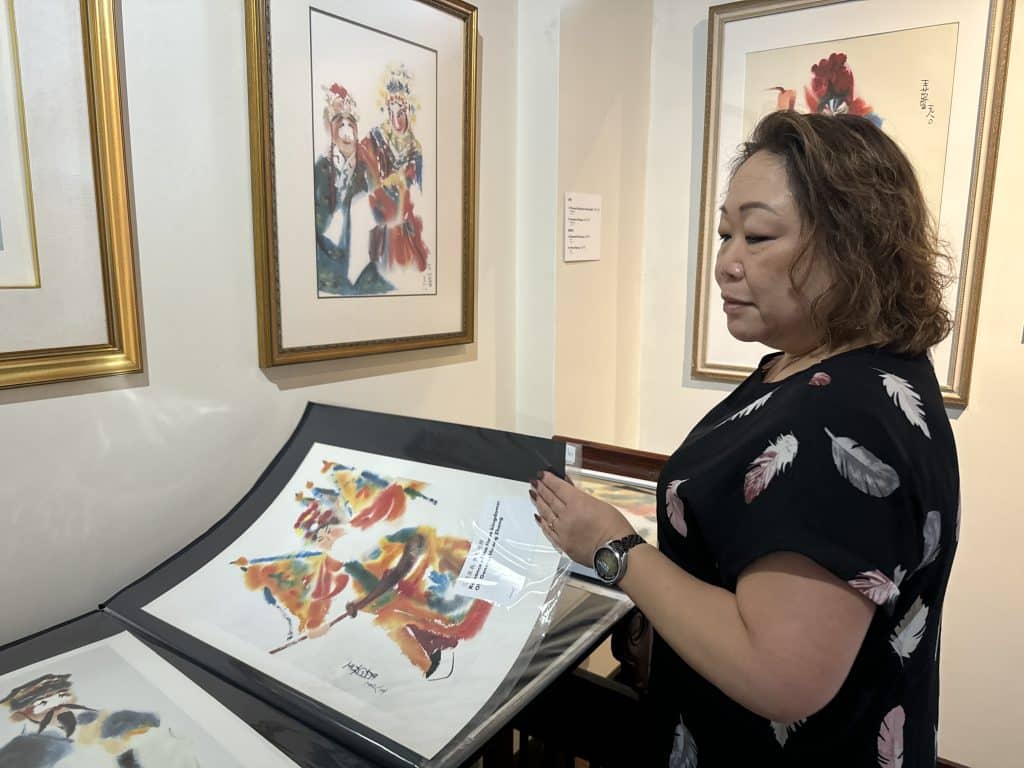
Currently, the museum features The Art of Chunming Yu and Lan Wang (art pieces are also for sale). In spring of 2026, Wong plans to feature an original exhibition about the Chinese community in Baja, California.
“The Colorado River Company had brought in Chinese folks to help build the [irrigation] infrastructure, just like they did [in San Diego],” Wong says. “Many Chinese people died because it was so hot and brutal, but many of them settled there. There were more Chinese than Mexicans in Mexicali in the early 1900s, which was fascinating.”
Last year, Wong brought out Asian comic book artists during Comic-Con to draw a crowd.
“That’s something of interest to me, and I think it could be interesting to folks here,” Wong says. “That’s how we make it more localized.”
Wong also plans on creating historical tours, which not only emphasizes Chinese historical sites in the area, but Black, Filipino and Japanese history as well.
“The goal of these tours is to share these stories,” she says. “I’m not just talking about Chinatown. I want to tell the stories of the Filipinos; I want to tell the story about how on Fifth and Market was the bus stop where the Japanese went to go to internment camps.”
Places like the Creole Palace and the Douglas Hotel, whose pasts were both deeply intertwined with segregation laws, are located just two blocks away from the museum.
Historian and genealogist Dr. Yvette Porter-Moore, whose work uncovers historical documentation of Black communities in San Diego County, does not believe that the City of San Diego manages historical and cultural landmarks well.
“When you compare [San Diego] to other cities throughout the United States, I think that we’re lacking in showcasing and representing different cultures,” Dr. Moore says. “We’ve lost many buildings. We can do these tours, but if the buildings are no longer standing, we need to have something in its place so that when people do these walking tours, they know more about the culture and history of downtown San Diego.”
Plans for the historical tours are in early stages of discussion, but the goal remains the same: to engage visitors to the historical attractions in the area with available historical knowledge.
“If you have any questions about the ‘Harlem of the West’ or the Filipinos or the Japanese, I want to ensure that we have a network here so that I can say, ‘You know what? I don’t have any more information for you [at the Chinese History Museum],” Wong says. “But you should reach out to this person.”
She wants to accurately preserve history.
“I want to tell stories that are informative,” Wong says. “What I’ve noticed is that there are a lot of tours in this area, and a lot of them are ghost tours – but that’s not what I want to do, right? I want to be historically accurate and not make up stories.”
The San Diego Chinese Historical Museum is open Friday through Sunday from noon to 4 p.m. SDSun