
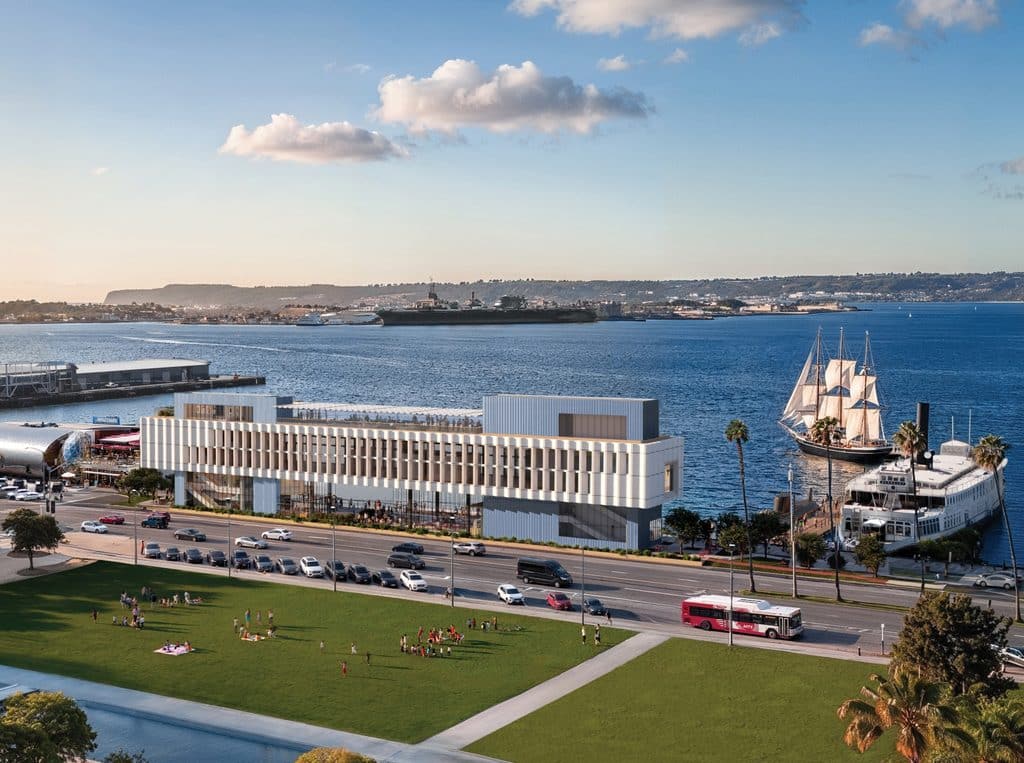
The Port of San Diego recently advanced plans for a new Maritime Museum building on the North Embarcadero to environmental review under the California Environmental Quality Act (CEQA).
While the museum serves an important cultural and educational role in San Diego, the $80-million “Gateway Project” proposal raises significant questions about its consistency with the Port Master Plan (PMP) and its impact on public waterfront access.
Notably, there was no public engagement or opportunity for public comment on the proposed project before it was presented at the November Port board meeting.
The Project Does Not Comply With The Port Master Plan
Compliance with the Port Master Plan is a legal obligation.
For more than 25 years, the PMP has called for a 100-foot-wide public Esplanade along the North Embarcadero. This area is intended to include a 25-foot waterfront promenade, a parkway, a bike lane and public plazas. The plan also specifies that the area east of the promenade must remain free of objects or furnishings that obstruct views of the Bay.
While some are praising the proposed museum, the building is not in compliance with these requirements.
In addition, the Port’s resolution to authorize the CEQA evaluation contains a fundamental flaw in its justification for the project. It states: “Whereas, the Site complies with exemptions outlined in BPC Policy No. 360 allowing District tenants to propose redevelopments of vacant property adjacent to their existing leasehold.”
The problem with this justification is that the site is not vacant property. It is public land designated for the Esplanade, a longstanding commitment in the Port Master Plan.
The Port’s failure to construct the Esplanade over the past 25 years also raises concerns about the enforcement of the Master Plan. The California Coastal Commission previously acted when the Port failed to deliver a park on Navy Pier near the Midway Museum for two decades.
Construction of Freedom Park ultimately moved forward following the threat of legal action. The Commission should consider whether similar enforcement measures are warranted to ensure the Port fulfills its longstanding commitment to build the Esplanade.
The proposed museum building would occupy a substantial portion of this designated public space. Although the design retains a 30-foot-wide waterfront promenade, the three-level building would extend 292 feet in length, rise 52 feet to the rooftop, and include structures reaching 75 feet. Its size and placement would significantly alter the waterfront experience, potentially obstructing views from inland areas and concentrating pedestrians into a narrower corridor.
The Port’s proposed Master Plan Update, currently under Coastal Commission staff review, also retains the 100-foot Esplanade. However, the Port has proposed changes to the plan’s language to accommodate the museum building, potentially at the expense of this longstanding legal commitment.
What Will The Building Mean For The Public?
The Embarcadero Coalition (I’m the co-chair) focuses on the pedestrian experience because public access is central to the Port’s mission. Much of the architectural presentation emphasizes aerial perspectives and views from the San Diego Bay. But what will visitors actually experience at ground level?
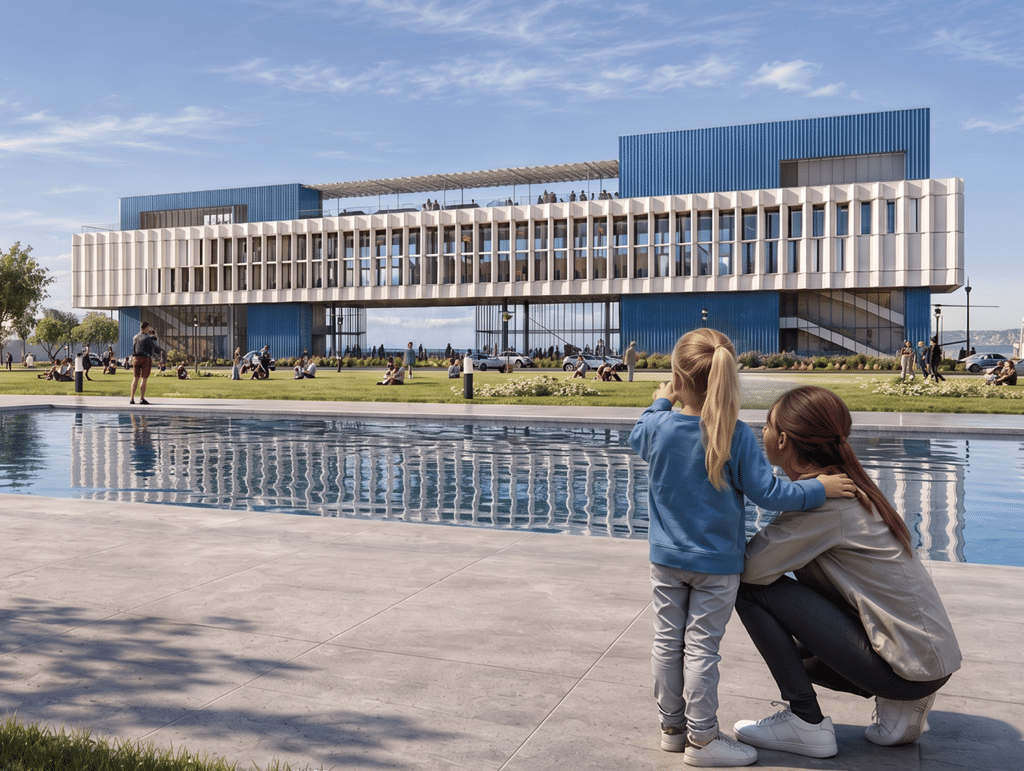
One image from the architects’ presentation shows a woman and child viewing the proposed building from the County’s Waterfront Park (above). This perspective illustrates the building’s scale and potential visual impact on the waterfront.
At nearly the length of a football field, the building would create a substantial wall along the Embarcadero and become a prominent feature of the waterfront. Its presence would change the relationship between public spaces, the bay and the historic ships.
Keep in mind that the proposed structure is a commercial building and the Port makes money from the museum. Once a large commercial building is built in the middle of the Esplanade, there is a reasonable concern that the Port will fill the whole area with money making buildings at the expense of public access.
Public access means more than providing a pathway along the water. It also means preserving open views of the bay and maintaining the visual connection between inland spaces and the waterfront. The proposed building raises concerns about both. (See the Maritime Museum Proposal.)
There Are Other Alternatives
The Maritime Museum has legitimate needs for meeting rooms and exhibition space. The Coastal Conservancy has noted that visitors may not immediately recognize the existing collection of historic ships as a museum because there is no single, unified entrance.
However, the museum could address these needs through alternatives that are less costly and less obstructive to public waterfront access.
One possibility would be a temporary building on a barge positioned parallel to the Berkeley (a steam ferryboat that’s part of the Maritime Museum). Over the longer term, an expanded museum district and park on the site currently occupied by the Wyndham San Diego Bayside hotel and the adjacent Navy building (1220 Pacific Highway) could provide an attractive location for additional museums while preserving the North Embarcadero’s public waterfront space.
What Happens To The Star Of India?
Under the proposal, the historic Star of India sailing ship would be relocated farther from the waterfront, near the end of a barge behind the Berkeley. Museum representatives say this arrangement would help protect the historic ship from storm waves by using the barge as a wave barrier.
However, moving one of San Diego’s most recognizable historic landmarks farther from the public waterfront raises questions about its visibility and accessibility. Is there a closer location that would still provide adequate protection?
Combined with a large building between inland areas and the bay, relocating the Star of India to the far end of the museum would fundamentally change the visitor experience.
Issues The Port Should Address
Before committing to an $80-million project, the Port should:
- Comply with the Port Master Plan’s longstanding commitment to a 100-foot-wide public Esplanade.
- Preserve public access and views of the Bay from both the waterfront promenade and inland areas.
- Evaluate less costly alternatives that meet the museum’s needs without compromising public waterfront space.
- Maintain the visibility and accessibility of the historic ships, particularly the Star of India.
Ultimately, the museum should be able to achieve its goals without sacrificing the openness, accessibility and public character of the Embarcadero. San Diego’s waterfront belongs to the public. Its future should reflect that commitment. SDSun
Columnist Janet Rogers is a downtown resident and co-chair of the Embarcadero Coalition, the Train Coalition at Santa Fe Depot, and Safe Walkways. For more information about the Embarcadero Coalition, contact Rogers at EmbarcaderoCoalition@gmail.com

